If you’re trying to choose between gymnastic rings and a TRX style suspension trainer, you’re not alone. Both are portable, scalable, and great for bodyweight training, but they don’t feel the same in real workouts. In this article, I’ll compare rings vs TRX in a practical way: which exercises each tool does best, how they differ for strength and muscle, what’s more beginner friendly, and what matters for travel and setup. By the end, you’ll know which one fits your goals and whether owning both actually makes sense.
Quick answer: which one should you pick?
If you want one tool for long term strength
If your goal is to build serious upper body strength and eventually learn skills like ring dips, muscle ups, or an L sit, gymnastic rings are the better bet. They offer more exercise options, more progression headroom, and usually a better price to versatility ratio.
If you want the easiest learning curve and leg friendly strap work
If you mainly want beginner friendly full body training, fast setup, and comfortable exercises with your feet in straps, a TRX style system is often the smoother choice. It’s very good for rows, core finishers, and supported leg work without needing a high anchor point.
My honest take
If you’re even slightly interested in calisthenics skills, I’d start with rings. They’re a bit more demanding, but they also teach you body control faster. If you’re focused on conditioning, rehab style training, or hotel workouts, TRX is hard to beat for convenience.
What gymnastic rings and TRX really are (and why it matters)
Gymnastic rings in one sentence
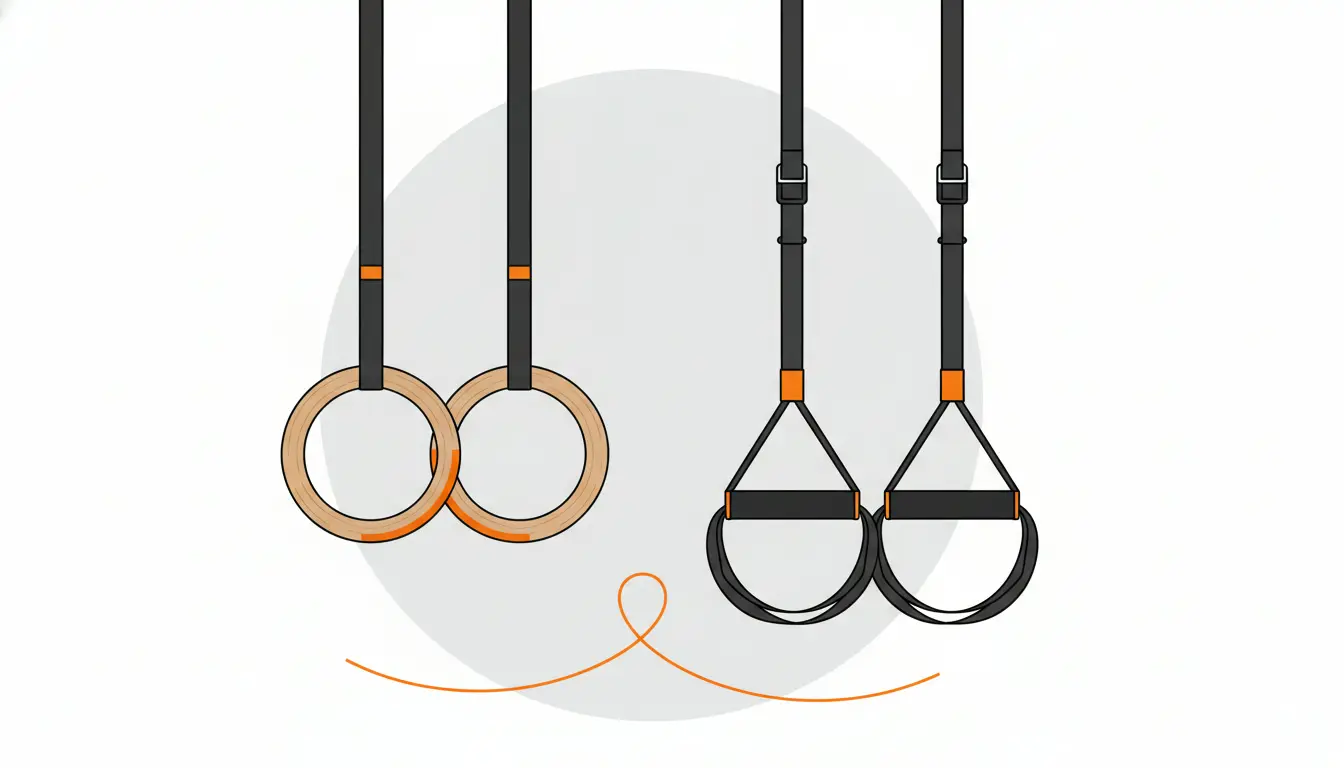
Gymnastic rings are two separate rings on two independent straps, usually hung from a bar, beam, or tree branch, and they can move freely in every direction.
TRX in one sentence
A TRX suspension trainer is two straps that meet at a single anchor point, with handles and usually foot cradles, designed to make angle based bodyweight training simple and scalable.
Why the anchor point changes everything
The biggest difference is not the handle shape. It’s the geometry. Rings hang as two separate lines, so you can set them shoulder width and keep the straps out of your way. TRX straps converge into a V shape, which is great for quick setup but can get annoying for certain pushing patterns.
Rings vs TRX: stability, difficulty, and progression
Instability: helpful, but only if you can control it
Rings are more unstable, which forces your shoulders, upper back, and core to work harder to keep you aligned. That’s great for building joint control and strong stabilizers, but it can also turn basic exercises into a shaky mess if you’re brand new.
TRX is typically more stable because both straps share one anchor. That makes it easier to learn clean movement patterns, especially for beginners doing rows, presses, and assisted single leg work.
Progression: both are scalable, but in different ways
With TRX, progression is usually about changing your body angle. Step forward, move your feet, and the exercise becomes harder. It’s simple and quick.
With rings, you can also change the angle, but you also unlock a bigger range of progressions: deeper range of motion, more demanding support positions, and true bodyweight strength movements like dips and muscle ups.
TRX progression is often faster to apply and easier to repeat.
Ring progression tends to have a higher ceiling and more carryover to calisthenics skills.
Both can build strength if you keep adding difficulty and keep your technique honest.
Exercise comparison: what each tool does best
Upper body pulling
Both tools are excellent for rows. TRX shines for quick grip changes and comfortable handles on higher rep work. Rings feel more “raw” and teach better shoulder positioning in my opinion, especially if you plan to move toward pull ups, front lever progressions, and other calisthenics goals.
For vertical pulling, rings win clearly. You can space them naturally and hang them high. TRX pull ups are possible but often awkward because the handles hang close together and you end up fighting the straps as they pull inward.
Upper body pushing
This is where the rings vs TRX gap becomes obvious. Ring push ups feel natural because the straps go straight up and stay out of your arms. On TRX, the V shape can rub your arms or limit your line in close grip variations.
For dips, rings are the real tool. A TRX setup usually blocks the movement because the straps converge above you. If dips are even on your “maybe someday” list, that’s a strong argument for rings.
If you want a clear dip path and stable setup at home, pairing rings with a solid mounting point matters. If you train outside, a sturdy bar or branch works fine.
Useful reference if dips are part of your plan: how to do a bodyweight dip.
Core training
TRX is great for core finishers like pikes, body saws, and roll outs, mainly because the foot cradles are comfortable and quick to get into. Rings can do most of these, but feet in rings can feel rough on the ankles and less secure.
Rings are better for static core strength skills like the L sit because you can support your body above the rings. That’s simply not what TRX is built for. If you want a practical roadmap, see how to train the L sit.
Leg training
For legs, neither tool replaces basic squats, lunges, step ups, or Nordic style work. But TRX is more comfortable for supported single leg squats, assisted pistol progressions, and hamstring curls with your heels in the foot cradles.
Rings can still be used for hamstring curls and assisted squats, but comfort is the limiting factor. The ring is hard and narrow compared to a foot cradle, so long sets can get annoying fast.
TRX advantage: comfort and speed for foot in strap exercises.
Ring advantage: better carryover if your leg work is part of a wider calisthenics skill plan.
Reality: most people still do their main leg volume on the floor.
Strength and muscle building: which is better for hypertrophy?
Why rings tend to win for upper body strength
For building upper body strength and muscle, the best bodyweight exercises are usually the ones that allow high tension, full range of motion, and long term overload. Rings are better positioned for that because they support true bodyweight pushing and pulling patterns: pull ups, deep ring dips, and eventually muscle ups.
TRX can absolutely build muscle, especially for beginners and intermediates doing rows, push ups, curls, and tricep extensions. But many people hit a ceiling where the hardest angle is hard to set up consistently or starts to feel more like a balancing drill than a strength set.
Instability: a tool, not a goal
More instability is not automatically better for hypertrophy. If the wobble limits the load too much, you end up training stability more than the target muscles. Rings walk a fine line here: they can be incredible for muscle building, but only if you choose variations you can control.
My rule is simple. If your reps look like you’re trying to hold onto a shopping cart on ice, regress the movement. Clean reps beat chaotic reps every time.
Beginner friendliness: which one is easier to start with?
TRX is easier on day one
TRX is usually the easiest entry point because you can keep at least one stable base, change the angle in seconds, and follow simple full body templates. It’s also less intimidating because most TRX movements start with feet on the ground and a controlled body line.
Rings are doable for beginners, with smart choices
Rings can be beginner friendly if you start with low ring height and basic patterns: ring rows, ring push ups with a limited range, and support holds with assistance. The learning curve is steeper, but the payoff is that you build shoulder stability and grip fast.
Start with rings set low enough that you can step off quickly.
Use slower tempos and stop sets before form breaks down.
Prioritize holds and control over fancy variations.
Comfort, grip, and joint feel
Handles vs rings
TRX handles are usually more comfortable for high rep arm work. They can rotate and they’re easier on the palms. Rings, especially wooden ones, feel more solid and “honest”. They can be tough on the hands at first, but many athletes end up preferring them because the grip is consistent and the ring position can rotate naturally with your wrists and shoulders.
Hands, calluses, and chalk
With rings, you will probably build calluses faster. That’s not a problem, but it’s worth managing. Keep your skin smooth and avoid gripping like your life depends on it. A small amount of chalk can help if your hands get sweaty, but it’s optional for most people.
Setup, portability, and where you can train
Home setup
At home, rings are fantastic if you have a reliable overhead point: a pull up bar, ceiling mount, or sturdy beam. Once they’re up, you can train almost everything you’d want in calisthenics.
TRX also works at home, but it’s at its best when you want quick circuits and you don’t want to adjust two separate straps to match height perfectly.
Travel and hotel rooms
This is where TRX often wins. A door anchor and one central attachment point makes it simple. Rings can travel too, but you need an overhead structure you trust. In a random hotel room, that’s not always available.
TRX: easiest in small spaces and unknown environments.
Rings: easiest when you can find a solid bar, branch, or playground.
Both: light enough to keep in a backpack, but your anchor options decide everything.
Safety and durability: what I’d pay attention to
Safety comes down to anchor quality and strap integrity
Whether it’s rings or TRX, the weak link is usually not the tool itself, it’s the anchor point and the stitching. If you train hard and often, check for fraying, worn stitching, and damaged buckles. If something looks questionable, replace it. Suspension training is not the place to push your luck.
Are off brand TRX systems okay?
There are two truths here. Many off brand suspension trainers work fine, and some feel identical in use. But quality control is inconsistent, and heavy use can expose weak stitching or hardware. If you only need something for occasional travel sessions, a decent non premium option can make sense. For frequent training, I’d prioritize build quality over branding.
Buying guide: what to look for (without overthinking it)
What to look for in gymnastic rings
Material: wood is usually grippier and feels better in the hands.
Strap length: longer straps give more options for high anchors.
Markings: numbered straps save time when matching height.
Buckles: smooth adjustment and solid locking matter more than fancy design.
What to look for in a TRX style suspension trainer
Door anchor quality: thick, durable, and secure stitching.
Handle comfort: especially if you do lots of rows and arm work.
Foot cradles: wider and softer is usually better.
Adjustment system: fast length changes make workouts smoother.
Two practical recommendations (subtle, but worth it)
If you choose rings: get a set you won’t outgrow
If you’re leaning toward rings, I’d rather see you buy one solid set once than replace cheap ones later. A dependable option is the Gornation wooden gymnastic rings: good grip, straightforward straps, and a setup that fits the way most calisthenics athletes actually train.
If you want better grip on either tool
If your hands get sweaty or you’re doing longer sessions, a small grip aid can keep your technique cleaner. I like Gornation liquid chalk because it’s simple, dries fast, and doesn’t turn your training space into a mess.
Grip details matter more than people think, especially when the limiting factor becomes hand fatigue instead of your back or chest strength. If you want to go deeper into that topic, see liquid chalk vs block chalk.
Sample workouts: rings vs TRX
A simple rings workout (strength focused)
This is a basic template I often use when someone wants strength without getting lost in complexity. Keep 1 to 2 reps in reserve on most sets.
Ring rows 4 sets of 6 to 10 reps
Ring push ups 4 sets of 6 to 12 reps
Ring support hold 5 sets of 10 to 20 seconds
Optional: assisted ring dips 3 sets of 3 to 6 reps
A simple TRX workout (conditioning friendly)
This works well as a travel session. Move steadily, rest as needed, and aim for clean reps.
TRX rows 3 sets of 10 to 15 reps
TRX chest press 3 sets of 8 to 12 reps
TRX hamstring curls 3 sets of 10 to 15 reps
TRX pikes or body saw 3 sets of 6 to 12 reps
When it makes sense to own both
The “rings at home, TRX for travel” setup
This is the most logical two tool combo. Rings cover your long term strength and skills at home. TRX covers hotel rooms, quick leg strap work, and easy circuits. If you train consistently and travel even a few times per year, this combo is genuinely useful.
When owning both is overkill
If you’re on a budget and you mostly train in one location with a solid pull up bar, rings alone can cover nearly everything you need. You can still do rows, push ups, core, and plenty of leg work on the floor. In that scenario, TRX is nice, but not necessary.
Veelgestelde vragen
Is gymnastic rings vs TRX mainly about strength vs cardio?
Mostly, yes. Rings lean more toward strength and skill progressions because they support dips, pull ups, and muscle up pathways. TRX leans more toward conditioning and scalable full body sessions. You can do hard workouts on both, but rings usually offer more long term strength progression.
Can you build muscle with TRX, or do you need rings?
You can build muscle with TRX, especially with rows, presses, curls, and tricep extensions taken close to failure. The limitation is long term loading for heavy pushing and pulling. If your goal is bigger strength moves like dips and muscle ups, gymnastic rings are the clearer path.
Which is better for beginners: gymnastic rings vs TRX?
TRX is typically easier for beginners because it’s a bit more stable and the progressions are straightforward through body angle changes. Rings can still work for beginners, but you need to start with controlled basics and accept that your first sessions will feel shaky while your shoulders and core adapt.
Are gymnastic rings harder on the wrists and shoulders than TRX?
They can be, mainly because rings demand more stabilization. The upside is that rings also allow your hands to rotate naturally, which many people find joint friendly once they have control. The key is pacing your progress and avoiding high volume ring dips or deep ranges before you’re ready.
For travel, is gymnastic rings vs TRX a clear win for TRX?
Usually, yes. TRX style systems with a door anchor are simply more consistent in hotels and small spaces. Rings can travel well too, but you need a trustworthy overhead anchor like a bar, beam, or sturdy branch. If your travel destinations are unpredictable, TRX is the safer bet.
In the gymnastic rings vs TRX debate, the best choice comes down to your goals and where you train. Rings are the stronger long term option for calisthenics strength because they unlock dips, muscle up progressions, and a huge variety of pushing and pulling patterns without straps getting in the way. TRX is easier to start with, faster to set up, and more comfortable for foot in strap exercises and travel workouts. If you can only buy one and you care about skills, I’d pick rings. If you want simple, consistent workouts anywhere, TRX is a solid choice.