How to choose the best low parallettes for your calisthenics goals
Your ideal low parallettes depend on your body, skill level, and where you train. The good news is that once you understand a few basics, choosing gets simple.
Low parallettes also pair well with core gear like a solid pull up bar setup so you can cover both pushing and pulling at home or outside.
Height and length: how low and how long?
For low parallettes, I like a height around 8–12 cm. This range keeps your wrists happier than flat floor work, gives space under your hands for L-sits, and keeps you close to the ground for safer handstand practice.
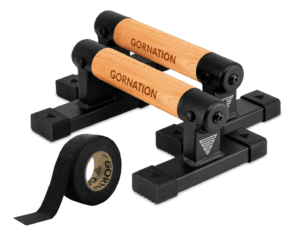
Short, compact bars like GORNATION Active are great for small spaces and travel. Longer bars like the Pullup & Dip set feel extra stable and give more room for hand placement and transitions. If you mostly do push ups and static holds, compact low bars are enough. If you plan to work on handstands and planche variations, slightly longer low bars feel nicer.
Material and grip: why wood often beats metal
For low parallettes, I usually prefer wood. Beech or pine handles absorb a bit of moisture, feel warm, and give a predictable grip during longer holds. Wood also softens the feel on your joints compared to a thin metal tube.
A handle diameter around 40 mm spreads pressure across the palm and can ease wrist and finger stress. Metal parallettes can also work well, especially outdoors, but for most beginners and intermediates, wooden handles feel more forgiving and build confidence faster.
Stability, weight limit, and safety features
Stability comes first. Wide feet and solid non-slip pads are non-negotiable, especially if you plan to practice handstands or dynamic push ups. Many quality low parallettes, like GORNATION and Pullup & Dip, are tested for tilt and have very high weight ratings, often several hundred kilos per pair.
Before each session, I like to place the bars on the ground, press them from different angles, and check for any wobble. Keeping the rubber feet clean from dust or sand also helps them grip better on smooth floors.
Portability, storage, and where you plan to train
If you carry your gear to the park or gym, compact models are your friend. GORNATION Premium Parallettes Active are a good example, they fit in most backpacks and are quick to set up.
If you mostly train at home and never move your setup, you can go a bit heavier for extra stability. Just remember that wood should stay dry. Rubber feet usually work well on surfaces like carpet, wood, tiles, asphalt, or tartan, but always check that the ground is flat.
Price vs quality: when to invest and when to save
Premium options like GORNATION and Pullup & Dip cost more, but you get smoother finishes, stronger construction, and more reliable stability. That matters if you train several times per week, are heavier, or aim for skills like handstands and planche progressions.
Budget options like Airogym are fine if you focus on push ups, planks, and basic L-sits, or if you just want to see how low parallettes feel. I see parallettes as a long-term training partner, so if you can stretch your budget a bit, higher quality usually pays off over the years.
Best exercises to do with low parallettes for calisthenics
Once you own a set, the key is using them for focused practice. Here are the groups of exercises I give most often to starters and intermediates.
Push exercises: wrist-friendly push ups and dips
Start with neutral-grip push ups on the bars. Your wrists stay straighter, you can go a bit deeper, and your chest and triceps work harder. You can progress to decline push ups, pseudo planche push ups with a forward lean, and bench-style dips with your feet on the floor.
Low parallettes also feel cleaner than training on rough concrete or a dirty gym floor.
Core and static strength: L-sits, tuck holds, and planche leans
L-sits are a classic. Sit between the bars, lock your arms, lift your hips, then try to raise your legs. If that is too hard, start with tuck sits or one knee in. These work your core, hip flexors, and straight-arm strength.
Planche leans are another key drill. From a plank on the bars, shift your shoulders past your hands and hold. The extra space under your hands means your feet and hips clear the floor more easily than on flat ground.
Handstands and balance work close to the floor
For handstands, I like to start with wall holds using low parallettes. You can do back-to-wall or chest-to-wall to build comfort. As you get stronger, you can practice small hops or gentle balance shifts.
Low height keeps the fall distance small and reduces fear. Stable sets like GORNATION Active or Pullup & Dip wooden parallettes give you a firm base so you can focus on shoulder and finger control.
Care, setup, and common mistakes with low parallettes
Low parallettes are simple, but a bit of care keeps them safe and feeling great for years.
How to set up your low parallettes safely at home or outside
Place the bars on flat, solid ground. Press on each corner to check for wobble before you step or jump on them. Non-slip pads work well on wood, tiles, rubber, carpet, asphalt, and tartan, as long as there is no loose dust or sand.
Start each session with easier moves, like planks or simple push ups, before trying explosive or heavy balance work.
Basic care tips for wooden low parallettes
Wood loves dry conditions. I wipe mine after each session to remove sweat, and I never leave them outside in the rain. If they get damp, I dry them with a towel and let them air out indoors.
From time to time, I check screws or joints, even if the set came pre-assembled, just to be safe.
Training mistakes to avoid on low parallettes
The biggest mistake is jumping straight into hard skills like planche or freestanding handstand push ups without basic strength. Others include letting your shoulders sink at the bottom of push ups, snapping into locked elbows with no control, or pushing through sharp wrist pain.
Take small progressions, use the wall for handstands, and if a joint hurts sharply, stop and adjust.
FAQ about low parallettes for calisthenics
Are low parallettes better than training on the floor?
For most people, yes. You get a neutral grip that reduces wrist strain, more range in push ups and L-sits, and handles that are easier to hold than a flat surface. They are also more hygienic than touching dirty ground.
Can beginners start with low parallettes, or should I be more advanced first?
Beginners can start right away. Begin with knee push ups, plank holds, and easy tuck sits. The low height keeps things safe and close to the floor, and you can pair them with basic pull work on a doorway bar or power tower.
How wide should I place my low parallettes?
For push ups and handstands, shoulder width or just a bit wider works well. For L-sits and dips, place them so your arms can move freely without scraping your hips, and you feel stable.
Are wooden low parallettes safe for outdoor training?
Yes, as long as you use them on stable ground and dry the wood after any contact with moisture. Rubber feet grip well on concrete, asphalt, or rubber mats, but you should store the bars indoors between sessions.
Do I really need premium low parallettes, or is a budget pair enough?
Both can work. Premium models give better grip, finish, and stability, which helps as you get stronger or heavier. Budget sets are fine for lighter training and basics. If money is tight, start with a simple wooden pair, then upgrade later if you outgrow them.
Conclusion
Low parallettes for calisthenics are a simple tool, but they can change how your training feels. They protect your wrists, increase range of motion, and open up a lot of push, core, and handstand work for beginners and intermediates.
My top picks are GORNATION Premium Parallettes Active for a small premium setup, Pullup & Dip wooden parallettes if you want low bars with extra length, and Airogym wooden push up stands if you need a budget-friendly entry point.
Pick the pair that matches your space, budget, and goals, then commit to a few core exercises done well. With the right low parallettes for calisthenics and smart progressions, you can build serious strength and control at home, in the gym, or outdoors.