You’re walking to the calisthenics park with rings bouncing against your side, bands tangled like spaghetti, chalk leaking into the corners of your bag, and a big water bottle rolling into everything. That’s the moment you realize the best gym bag for calisthenics isn’t just “a bag”, it’s a tool that keeps awkward gear under control.
Calisthenics equipment has odd shapes, dirty contact points (bars, ground, tree branches), and small items you can’t afford to lose (grips, wrist wraps, tape). A good bag keeps it organized, stays comfortable on the way to training, and doesn’t fall apart when you use it outdoors.
Below you’ll start with two strong picks from GORNATION, then you’ll learn how to choose the right style based on how you train and how you get to your workouts.
Top picks: the two best gym bags for calisthenics
If you want one bag that handles park sessions, gym days, and normal life, go with a backpack. It carries weight better, keeps both hands free, and usually has more “small-item” storage.
If you mainly train in a gym or drive to the park, a duffel-style sports bag can feel faster. You unzip it wide, see everything, grab what you need, and you’re moving.
Both options below are built around what you actually carry in calisthenics: rings or straps, resistance bands, a towel, an extra shirt, a big water bottle, grips, sleeves, wraps, and chalk.
GORNATION tactical backpack, best all around bag for calisthenics
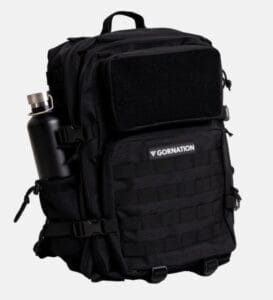

If your training life overlaps with work, school, or travel, this backpack fits that reality. You get about 10.6 gal of space (about 40 L), so it can swallow your rings, bands, towel, and a change of clothes without playing suitcase Tetris.
The build matters for outdoor training too. The body uses 600D polyester, designed to take scuffs and rough handling, and it’s rated for up to about 55 lb of load (25 kg). That’s more than enough for a full kit, plus extras like a light jacket and food.
What makes it work for calisthenics is the layout:
- Mesh inner pockets help you separate small gear like wraps, grip tape, and chalk.
- Three front zip pockets keep quick-grab items (phone, keys, wallet) easy to reach.
- Two side bottle pockets fit large bottles, up to about 34 oz (1,000 ml).
You also get a padded laptop compartment that fits devices up to 17 in, which is huge if you go straight from your day to the bar. The ergonomic shoulder straps help when your bag is heavy with water and gear.
For growth and personalization, the front has MOLLE loops so you can add extra pouches, and there’s a version with hook-and-loop patches if you like customizing your kit. It’s also commonly usable as carry-on luggage with many airlines, which makes it a solid “one bag” option for training trips.
Care and ownership details are straightforward: don’t machine wash it, wipe it clean with a damp cloth. You can start returns within 1 month after delivery, and there’s a 6-month warranty for production or material defects. If you want a broader list of small add-ons worth packing with it, see https://calisthenics-equipment.com/best-calisthenics-accessories/.
GORNATION Premium Sports Bag 2.0, best gym and park duffel

A duffel makes sense when you want simple packing and fast access. You open the top, everything is right there, no digging down through a tall main compartment. That’s nice when you’re mid-session and need chalk, bands, or grips quickly.
This bag sits around 7.9 gal (about 30 L), which is plenty for most calisthenics sessions if you pack smart. The standout feature is the shoe tunnel with ventilation eyelets. If you bring lifters for weighted dips, running shoes, or muddy park shoes, separating them from clothes and fabric gear keeps the rest of your kit cleaner.
Outdoor-friendly details matter here too. The bottom uses coated material, it’s water-resistant, and the bag has protective feet so it doesn’t soak up grime when you set it down.
Carry comfort is flexible: you get a removable shoulder strap for over-the-shoulder carry, plus padded hand straps for quick grabs. Storage is practical rather than flashy: a large main compartment, mesh pockets on the sides and inside, and durable zippers so you’re not fighting the bag when you’re in a hurry.
Cleaning is the same rule as the backpack: don’t machine wash, wipe with a damp cloth. Returns can be started within 1 month after delivery, and you get a 6-month warranty for production or material defects.
How to choose the best calisthenics gym bag for your training style
Choosing a calisthenics gym bag is less about fashion and more about friction. The right bag removes small annoyances that can derail a session. No more rummaging for wraps, no more chalk dust on your clean shirt, no more shoulder pain on the walk home.
A simple way to decide:
- Backpack: best if you walk, bike, commute, or travel.
- Duffel: best if you drive, want wide-open access, or need shoe separation.
- Hybrid (less common): fine if you want backpack straps with a duffel opening, but only if the structure is stable when loaded.
Calisthenics gear is awkward. Rings and straps lie flat but get tangled, bands bunch up, chalk spills, and sweaty clothes stink fast. Your bag should have pockets and separation points that match that mess.
Size and layout, what you actually need to fit rings, bands, chalk, and a big bottle
Most sessions come down to a predictable kit. If you pack the same way every time, you show up calm and ready.
A realistic calisthenics packing checklist looks like this:
- Rings or suspension straps
- Resistance bands (warm-up, assistance, mobility)
- Towel and extra shirt
- Grips, wrist wraps, or sleeves
- Chalk or liquid chalk
- Jump rope (optional)
- Notebook or notes app, if you track sets
- Water bottle (around 34 oz is common)
In practice, a bag in the 8 to 11 gal range (about 30 to 40 L) usually covers all of that, plus a change of clothes, without feeling like you’re hauling luggage to the park.
The bigger win isn’t just size, it’s smart pockets. A huge empty sack turns into a black hole where your wraps disappear and your chalk gets crushed into everything.
Comfort and durability, straps, tough fabric, and an easy to clean bottom
If you train outside, your bag becomes part of the environment. It hits concrete, sits on dirt, and gets dragged around benches.
Comfort matters because calisthenics gear is deceptively heavy once you add water. Padded straps help a lot when you carry rings, a towel, and a full bottle. If you’re mostly a gym-only person, padded handles and a shoulder strap can be enough, since your carry time is shorter.
For durability, look for tough fabric that resists abrasion, strong zippers that don’t snag, and a bottom that can handle wet ground. The simplest maintenance habit is also the most effective: wipe it down after outdoor sessions instead of washing it. You keep the bag cleaner, and you avoid damaging coatings and structure.
Backpack vs duffel for calisthenics, which one should you buy
This choice is really about movement and access. How do you get to training, and how often do you need to grab small items mid-session?
Use the backpack model as your “carry comfort” option, and the duffel model as your “open and go” option. Both can work, but one will fit your routine better.
Choose a backpack if you walk, bike, or travel, and want hands-free carry
A backpack spreads the load across both shoulders and stays stable when you move. That’s helpful when you’re walking to a park, biking across town, or carrying gear after a tough session when your grip is already cooked.
A laptop sleeve is also more useful than it sounds. If you train before work, on a lunch break, or after school, being able to carry a device safely changes what “one bag” means.
Expandable options like MOLLE loops are a bonus if your kit grows over time, like adding a small pouch for chalk, tape, or first-aid basics. If travel is part of your training life, this guide can help you pack smarter: https://calisthenics-equipment.com/best-calisthenics-travel-equipment/.
Choose a duffel if you want quick access, a shoe compartment, and simple packing
A duffel opens wide, so you can see your gear in one glance. You don’t waste time fishing for bands or digging under clothes for your grips. For park sessions, that speed is nice when it’s cold out and you want to keep moving.
Shoe separation is the other big reason. If you rotate between training shoes, lifters, or you end up with wet shoes from outdoor ground, a ventilated shoe tunnel keeps the rest of your bag cleaner and less smelly.
Over-the-shoulder carry is fine for short trips, gym-only routines, or when you’re driving and only carrying the bag from the car to the entrance.
Quick buying checklist and smart packing tips
A gym bag shouldn’t create work. It should remove it. Use the checklist below to avoid buying something that looks good online but annoys you every training day.
Before you buy, check these features first
- Capacity that matches your kit (most people do well around 8 to 11 gal)
- Enough pockets for small items so nothing gets lost
- A real spot for a large water bottle (around 34 oz)
- Comfortable straps (backpack) or padded handles (duffel)
- Water-resistant bottom if you train outdoors
- Durable fabric and zippers
- Easy cleaning (wipe-down, not machine wash)
- A clear return window (many brands offer around 30 days)
- A real warranty (even short coverage beats none)
If wrist support is part of your regular pack, it helps to understand what it actually does for your training, not just comfort. Start here: https://calisthenics-equipment.com/benefits-of-wrist-wraps-in-calisthenics-and-streetlifting/.
How to pack your bag so you can train faster
Use a simple system that stays the same every time:
- Keep chalk and grip tape in a small pouch so it can’t dust your clothes.
- Roll bands instead of stuffing them, they last longer and don’t knot up.
- Store ring straps flat so you can hang them fast.
- Put sweaty clothes in a separate pocket or a thin drawstring bag.
- Keep keys and phone in a front pocket so you don’t dump your bag on the ground.
- Refill water before you leave, not at the park.
Good organization makes you more consistent because you spend less time searching for gear, and more time training.
Conclusion
If you want one do-it-all option, the GORNATION Tactical Backpack is the best all around pick for comfort, organization, and daily use. If you prefer a gym-focused duffel with fast access, shoe separation, and a water-resistant base, the Premium Sports Bag 2.0 fits that job. Pick the style that matches how you get to training and what you carry most often, and you’ll feel the difference in every session because your bag stops being the weak link.