How to choose the best bands for your calisthenics goals
The “best” band isn’t the strongest one, it’s the one that gives you clean reps. You’re either using bands for assistance (making pull-ups, dips, and skills doable) or for extra resistance (making push-ups, dips, and legs harder). Pick based on the movement, not your ego.
A set with multiple resistances is usually the smartest buy, because your needs change across exercises and across the year.
Pick the right resistance for pull-ups, muscle-ups, and dips
Start with more help than you think you need. Your goal is to practice the groove, not survive the rep.
A simple rule of thumb for pull-ups:
- If you can do 0 to 2 strict pull-ups, start with a heavy band.
- If you can do 3 to 6, start with a medium band.
- If you can do 7 or more, use a light band to add volume or tighten technique.
Bands also help you in a specific way through the rep: you’ll get more help at the bottom (where you’re weakest) and less help near the top. That’s good, but it also means sloppy reps still look sloppy. Keep your ribs down, control the swing, and own the descent.
If you’re between sizes, you can combine two lighter bands instead of jumping straight to the thickest option. This also lets you “downshift” gradually as you get stronger.
Choose band type and size that works on bars, rings, and at home
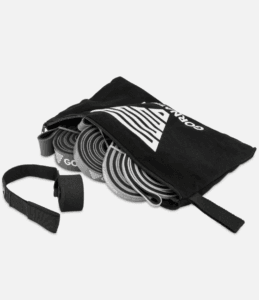
For calisthenics, you want loop bands (often called 41-inch style). They wrap cleanly over a pull-up bar, work well for dip stations, and also pair nicely with rings for drills.
Handled tube sets can still be useful for curls and presses with a door anchor, but they’re usually less convenient for bar-based assistance and static skill practice. Loop bands are faster to set up and easier to scale by simply changing band thickness.
Your band setup is only as good as your anchor point. Use a stable bar, and if you’re still choosing one, check Best pull-up bars for calisthenics training. Before every session, do three quick safety checks: look for damage, keep the band off sharp edges, and don’t stretch past what you can control.
What you can train with resistance bands in calisthenics
Bands aren’t just “pull-up helpers.” They’re more like a volume knob for your whole program. Turn difficulty down to learn positions, or turn it up to build strength without changing equipment.
Warm-up, mobility, and recovery that protects your joints
If your shoulders feel creaky, bands can make your warm-up feel like oil in a stiff hinge. You’re not trying to get tired here, you’re trying to move well.
A practical band warm-up can hit:
- Shoulders and upper back: band pull-aparts, shoulder pass-throughs (controlled), scapular activation
- Elbows and wrists: light extensions and flexion work, gentle pulsing ranges
- Hips and ankles: hip openers, glute activation, ankle mobility
Bands also fit perfectly before heavier leg-focused training because you can wake up hips and glutes before squats and hinge patterns. After training, light band stretching can help you cool down without forcing range.
If you travel or train outdoors a lot, bands are the easiest tool to keep consistent. Pair them with a compact setup from Portable calisthenics gear for outdoor workouts.
Strength and skill progressions, from push-ups to planche drills
Bands shine when a move is almost there, but not quite. You still do the real movement pattern, just with the difficulty scaled to your level.
High-value calisthenics band work includes:
- Band-assisted pull-ups and chin-ups: better reps, more volume, faster learning
- Muscle-up transition drills: practice the turnover without rushing
- Band-assisted dips: build depth control and confidence
- Front lever and planche positioning drills: lighter bands help you learn shapes and tension
- Band-resisted push-ups and dips: loop the band across your upper back for extra load
One simple rule keeps it honest: use the band to make hard moves doable, but keep reps slow and clean. If you’re bouncing, you’re training the band more than your body.
Conclusion
If you want the best overall experience and long-term progression, go with GORNATION for the premium feel, full range of band strengths, and durable double-layer build. If you want a lower-cost set that still covers real calisthenics needs, LEEKEY is a solid budget option with clear progressive resistance.
Your next step is simple: choose a set with multiple resistances, start with enough help for clean reps, then downshift bands as you get stronger. Keep it safe, inspect your bands often, store them out of heat and sun, and replace them when wear shows up. That’s how you get progress that lasts.