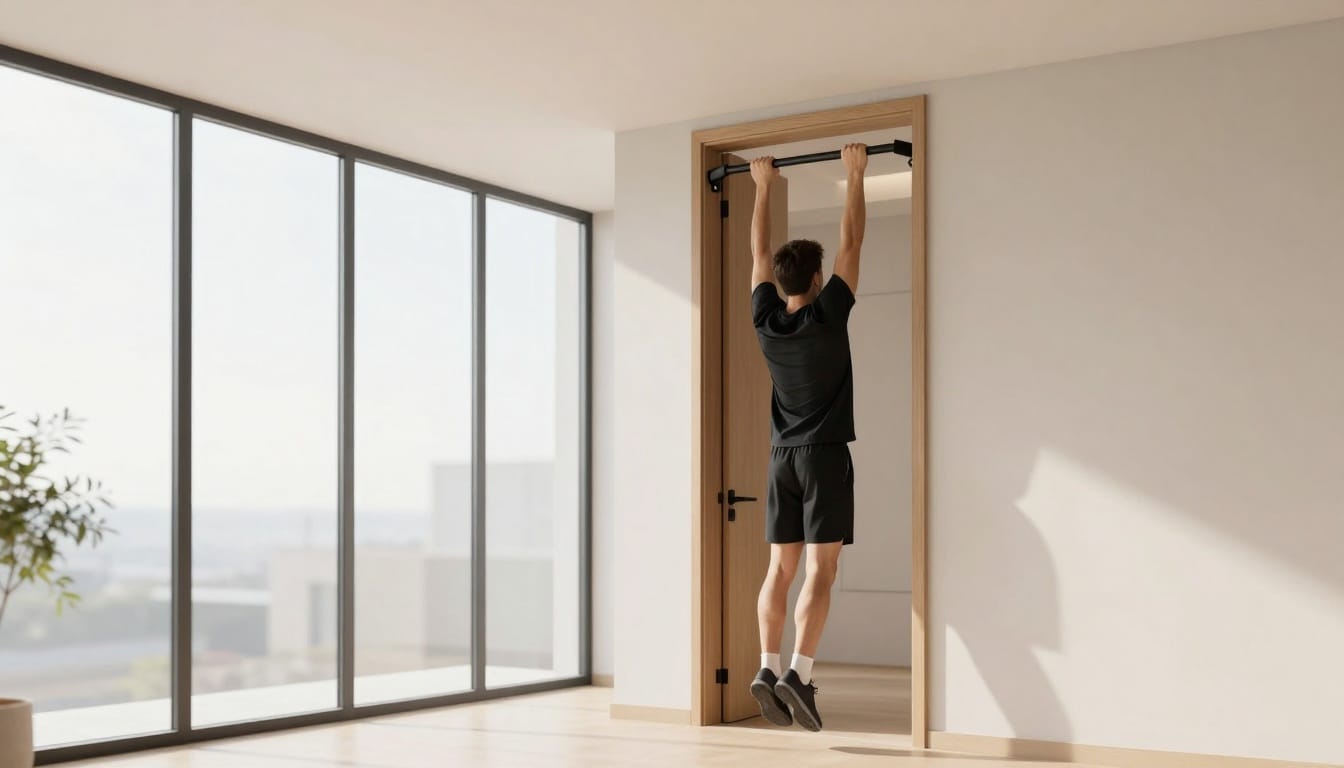
Hook-style bars hang over the top of the door frame and use leverage to lock in. “Anchored” here means resting on the frame and trim, not screwed in.
For many renters, this style feels more stable than a pressure-fit bar because your bodyweight helps keep it seated. The tradeoff is that the contact points can scuff trim or compress soft wood over time.
Common risks:
- Scratched paint or dented molding where it rests.
- Cracked trim if the casing is thin or already loose.
- Bad placement can make the bar feel crooked.
How to lower the risk:
- Add pads at every contact point (more on that below).
- Place it exactly as the manual shows, centered and flush.
- Don’t use it on damaged trim, even if it “seems fine.”
Make sure it actually fits, a quick renter checklist
Buying the wrong bar is how renters end up with returns, marks on the door, or a setup they don’t trust. A few minutes of measuring saves a lot of stress.
Use this quick checklist before you buy:
- Measure doorway opening width in cm (inside edge to inside edge).
- Measure frame depth in cm (front of trim to back of trim where the bar must sit).
- Check clearance above the door in cm, you need space for the top hooks or your head.
- Confirm door swing direction. Some hook bars only work well on one side.
- Read building rules. Some rentals ban “exercise equipment mounted to fixtures,” even if it’s no-drill.
- Think about ceiling height. You need enough room for a dead hang and full range reps.
If your goal includes high reps, core work, or basic strength, doorway bars are often enough. If your plan includes weighted pull-ups or hard swings, you’ll need more stability.
Measure your door frame and spot weak trim
Measure four things:
- Opening width: the clear space the bar spans.
- Frame depth: how much “ledge” exists for a hook bar to grab.
- Trim thickness: thick trim is usually stronger, thin trim chips easier.
- Clearance above the door: space for the bar plus head room.
Red flags that matter in rentals:
- Loose casing that moves when you press it.
- Hollow trim that sounds empty when tapped.
- Uneven surfaces (one side proud, one side recessed).
- Old paint layers that chip if you rub them.
Metal door frames are common in some apartment buildings. They can be strong, but they’re also smooth. Some pressure-fit bars can slip on slick metal unless the end grips bite well.
Match the bar to your body weight and training plan
A load rating is a starting point, not a promise for every style of training. Real forces rise fast when you add:
- Swinging reps
- Kipping
- Fast negatives
- Weighted pull-ups
If you’re a beginner doing strict reps, most quality doorway bars can work well, as long as your frame is solid. If you’re heavier, training streetlifting, or planning to add weight, a freestanding station is often the safest renter choice because it removes the doorway from the equation.
To plan workouts that fit your setup (and avoid moves that cause too much swing in tight rooms), see: Pull-up bar exercise guide.
Protect your door, walls, and deposit
Think of your rental like a white shirt at pasta night. It can survive, but only if you act like stains are real.
Most damage comes from grit, friction, and repeated pressure in the same spots. A little protection makes doorway training far more renter-safe.
Simple ways to prevent marks and dents
Cheap, renter-friendly protection that works:
- Felt pads: good for paint and light contact points.
- Rubber pads: better grip and better shock absorption.
- A folded towel: quick fix, but can slip if it bunches.
- Removable grip tape on contact points: avoid strong adhesives that can pull paint.
Where to place padding:
- Pressure-fit bar: pad where the ends press into the frame, keep surfaces clean so grit doesn’t grind into paint.
- Hook-style bar: pad the top edge that sits on trim and the rear contact points that brace against the other side.
Before you mount anything, wipe dust off the frame. Tiny bits of grit can scratch paint like sandpaper.
Safe use rules in a small apartment
Doorway bars are for controlled reps. Treat them that way.
- Test stability before every session. A 5-second check beats a fall.
- Use slow reps and controlled lowering to reduce noise and shaking.
- Don’t train with wet hands, sweaty hands are fine, slippery hands aren’t.
- Skip doorway bars if trim is damaged, or if kids are playing nearby.
- Avoid big swings. If you want dynamic moves, pick a freestanding station.
If you share the space, take the bar down when you’re done, especially if the door needs to close for privacy or airflow.
If doorway bars are not an option, go freestanding