Ever packed for a trip and wondered how you are supposed to keep training without stuffing half your home gym into a suitcase? That is exactly where most people get stuck. You want gear that is light, useful, and reliable, but not equipment that ends up sitting in your bag unused. In this guide, I will walk you through the best calisthenics travel equipment for real world training in the United States, whether you are working out in a hotel room, at a park, or outside an Airbnb. You will learn what is actually worth packing, what to skip, and how to build a simple travel setup that still lets you train hard.
Why Calisthenics Travel Equipment Is Different From Regular Gear
Travel calisthenics gear has one job that regular gear does not. It needs to earn its place in your bag. At home, you can justify a bulky dip station, a full size pull up bar, or heavy parallettes because they stay in one place. When you travel, every inch and every pound matters.
That changes how I look at equipment. The best travel calisthenics equipment is not always the best piece of gear overall. It is the item that gives you the most training options with the least hassle. In practice, that usually means rings, bands, a compact suspension trainer, and sometimes a portable pull up bar for travel if your trip makes sense for it.
I have trained during road trips, work trips, and long weekends where space was limited and time was tight. The biggest lesson is simple. Portable gear only helps if you will actually use it. If setup takes too long or the item is awkward to carry, it often stays packed. That is why minimalist equipment usually wins.
Another difference is training environment. At home, you know your setup. On the road, you may have a hotel room with thin walls, a park with great bars, or an Airbnb with a door frame that should not be trusted. Good travel equipment needs to handle uncertainty. It should work indoors and outdoors, be easy to inspect for safety, and adapt to different training styles.
If you want a broader overview of compact gear options, this guide on best portable calisthenics equipment is also worth reading after this article.
What to Look for in Portable Calisthenics Equipment
Before buying anything, think less about hype and more about tradeoffs. A product can be great in general and still be a poor fit for travel. The right choice depends on your training level, destination, and how often you move around.
Weight and Pack Size
This is the first filter. If an item is too heavy or awkward, you will notice it every time you carry your backpack through an airport or load your car. Bands are the obvious winner here because they take almost no space. Gymnastic rings are also much more compact than people expect, especially minimalist wooden or polymer ring sets with lightweight straps.
An ab wheel is small enough for some trips, but it is still bulkier than bands. A portable pull up bar for travel can work for road trips or longer stays, but for flights it is often more trouble than it is worth unless you know you will use it daily. A door frame pull up bar for travelers sounds convenient, but the shape can be awkward in luggage and not every property allows it.
Versatility Per Item
If I am packing light, every item has to cover multiple movement patterns. This is why rings and bands are such a strong combination. Rings handle pushing, pulling, core, and skill work. Bands help with warm ups, assisted pull ups, added resistance, rehab, and mobility. Together, they let you train almost everything.
This matters more than having the perfect single purpose tool. For example, a dedicated push up bar may feel nice, but rings can already cover push ups, rows, dips, support holds, and more. A suspension trainer is also strong here because it is fast to set up and beginner friendly. It does not fully replace rings for advanced strength work, but it gives a lot of value in a small package.
Durability on the Road
Travel is hard on gear. Equipment gets stuffed into bags, left in hot cars, used on rough outdoor surfaces, and exposed to dirt and moisture. Cheap products usually show their flaws fast. I have seen low quality bands start to crack early and badly finished handles become uncomfortable after only a few sessions.
This is one reason I often recommend GORNATION for travel friendly calisthenics gear. Their rings and resistance bands are generally well made, easy to trust, and designed by people who actually understand bodyweight training. When you are far from home, dependable equipment matters more because replacing it is not always easy.
If you want to compare options more deeply, their ring and band categories are the types of products I would prioritize first over flashy add ons.
The Best Calisthenics Travel Equipment: Our Top Picks
Below are the pieces I would seriously consider for a travel setup. I am focusing on equipment that works well in real conditions, not just products that look good on a product page.
Best Gymnastic Rings for Travel
Gymnastic rings are still my top pick for the best travel calisthenics equipment overall. If I could only bring one item, it would usually be rings. They give you rows, push ups, dips, support holds, face pulls, curls, triceps extensions, hamstring curls, and core work in one compact setup.
For travel, I would look for rings with comfortable straps, clear markings, and a design that packs small. GORNATION Workout Rings are a strong option because they are reliable, comfortable in the hands, and easy to recommend for both beginners and experienced athletes. Wood rings tend to feel better than slippery plastic, especially if your hands sweat.
The main downside is setup. Rings need a secure anchor point such as a pull up bar, a strong beam, or a sturdy tree branch. In a hotel room, that is not always available. So rings are amazing, but they are best when your trip includes outdoor access or a known anchor point.
When people ask me about resistance bands vs rings for travel, my answer is this. Rings are better if you want the most complete strength tool. Bands are better if you want the easiest thing to pack and use anywhere. Ideally, bring both.
Best Resistance Bands for Travel
Resistance bands are the easiest recommendation on this list. They are cheap relative to most gear, extremely portable, and useful for almost every level. If your goal is to figure out how to workout with resistance bands while traveling, start with one light band and one medium or heavy loop band.
GORNATION Premium Resistance Bands are a smart choice here because the quality is good and the range covers warm ups, assisted pull ups, mobility work, and loaded bodyweight exercises. On the road, I use bands for shoulder prep, push up resistance, split squat resistance, rows, curls, triceps work, and assisted skill practice. They also help if a trip leaves you feeling stiff from flights or long drives.
People often ask, can you bring resistance bands on a plane. In the United States, bands are generally fine in checked or carry on luggage, but airline and TSA decisions can always vary. In practice, simple loop bands are usually no issue. I still pack them neatly and keep them visible so they are easy to inspect if needed.
If bands are your main tool, this guide on best resistance bands for calisthenics can help you choose the right set.
Best Suspension Trainer for Travel
A suspension trainer deserves more attention in this conversation. Compared with rings, it is often faster to set up and easier for beginners to use in small spaces. You can anchor it to a sturdy door, tree, or beam and train rows, presses, split squats, hamstring curls, and core work quickly.
So what about suspension trainer vs gymnastic rings for travel? If you are a newer athlete, train mostly in hotel rooms, or want the simplest setup possible, a suspension trainer is often the better choice. If you care more about advanced calisthenics strength, ring support, dips, and long term progression, rings still win.
I usually see suspension trainers as the easier tool and rings as the more powerful tool. That does not mean easier is worse. For many travelers, easier means more consistent training.
Best Portable Pull-Up Bar for Travel
This category is useful, but only for the right traveler. A portable pull up bar for travel can be fantastic if you are driving, staying somewhere for a week or longer, or know you have a suitable door frame. For quick flights or uncertain lodging, I am more cautious.
A good door frame pull up bar for travelers should be stable, easy to install without hardware, and compatible with common US door frames. GORNATION has options in this category that are worth considering if pull ups are a non negotiable part of your trip. Still, always check the width and trim depth of the door frame before you rely on one.
I have learned to treat door frame bars as trip specific, not universal. In some rentals they are perfect. In others, they feel sketchy or simply do not fit. If you want a dedicated comparison, this page on portable pull up bar calisthenics is useful.
| Equipment | Best for | Packability | Main advantage | Main limitation |
|---|---|---|---|---|
| Gymnastic rings | Full strength training outdoors or with a solid anchor | High | Most versatile all around tool | Needs a safe anchor point |
| Resistance bands | Carry on travel, hotel room workouts, mobility | Very high | Lightest and easiest option to use anywhere | Less complete for advanced pulling work |
| Suspension trainer | Beginners and indoor travel setups | High | Fast setup and very beginner friendly | Less powerful than rings for advanced calisthenics |
| Portable pull-up bar | Longer stays, road trips, pull up focused training | Low to medium | Makes pull ups possible in the right location | Bulky and not always compatible with door frames |
| Ab wheel | Core focused travelers with a bit of extra space | Medium | Excellent core training in a small package | Limited versatility compared with rings or bands |
Best Ab Wheel for Travel
The ab wheel is underrated for travel because it gives you brutally effective core work in a tiny package. If you already know how to use one with good control, it is a solid addition to a backpack or car setup. Rollouts train anti extension strength, shoulders, lats, and trunk control in a way that carries over well to calisthenics.
That said, it is not essential for most people. If your bag is very limited, rings or bands give more overall value. I bring an ab wheel mainly on road trips or when I know I will have enough space. For hotel room training, it can work well on carpet or a mat, but hard floors may feel rough on the knees unless you pack a towel or small pad.
How to Build a Minimalist Calisthenics Travel Setup
Most people do not need five or six pieces of gear. They need a setup that matches their trip and training style. Here are the two versions I recommend most often.
The Carry-On Setup (Ultra Light)
If you are flying with only a carry on, keep it simple. I would pack one or two resistance bands, a jump rope if you use one, and maybe liquid chalk if your training style depends on grip and the bottle is travel sized and secure. For many travelers, this is enough to cover upper body, lower body, mobility, and conditioning.
With this setup, you can handle push ups, band rows, band overhead presses, curls, triceps work, split squats, squats, glute work, and core circuits. It is not the most exciting setup, but it is practical and easy to use in almost any hotel room.
If you want to learn more movement options, check out exercises with resistance bands.
The Full Backpack Setup (More Options)
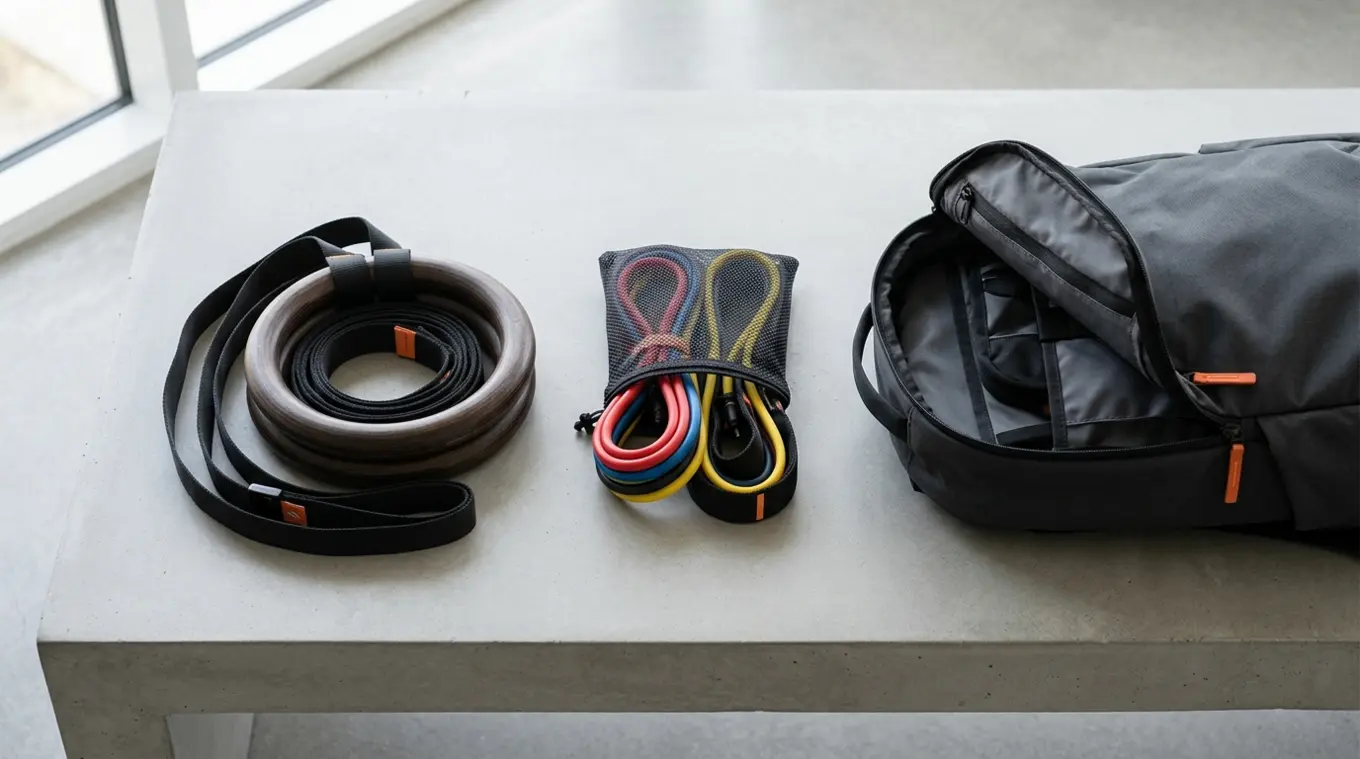
If you have a backpack and a bit more room, my favorite combo is gymnastic rings plus resistance bands. This is the setup I trust most when I want a real training week, not just maintenance. It covers strength, skill, hypertrophy, and mobility better than anything else at this size.
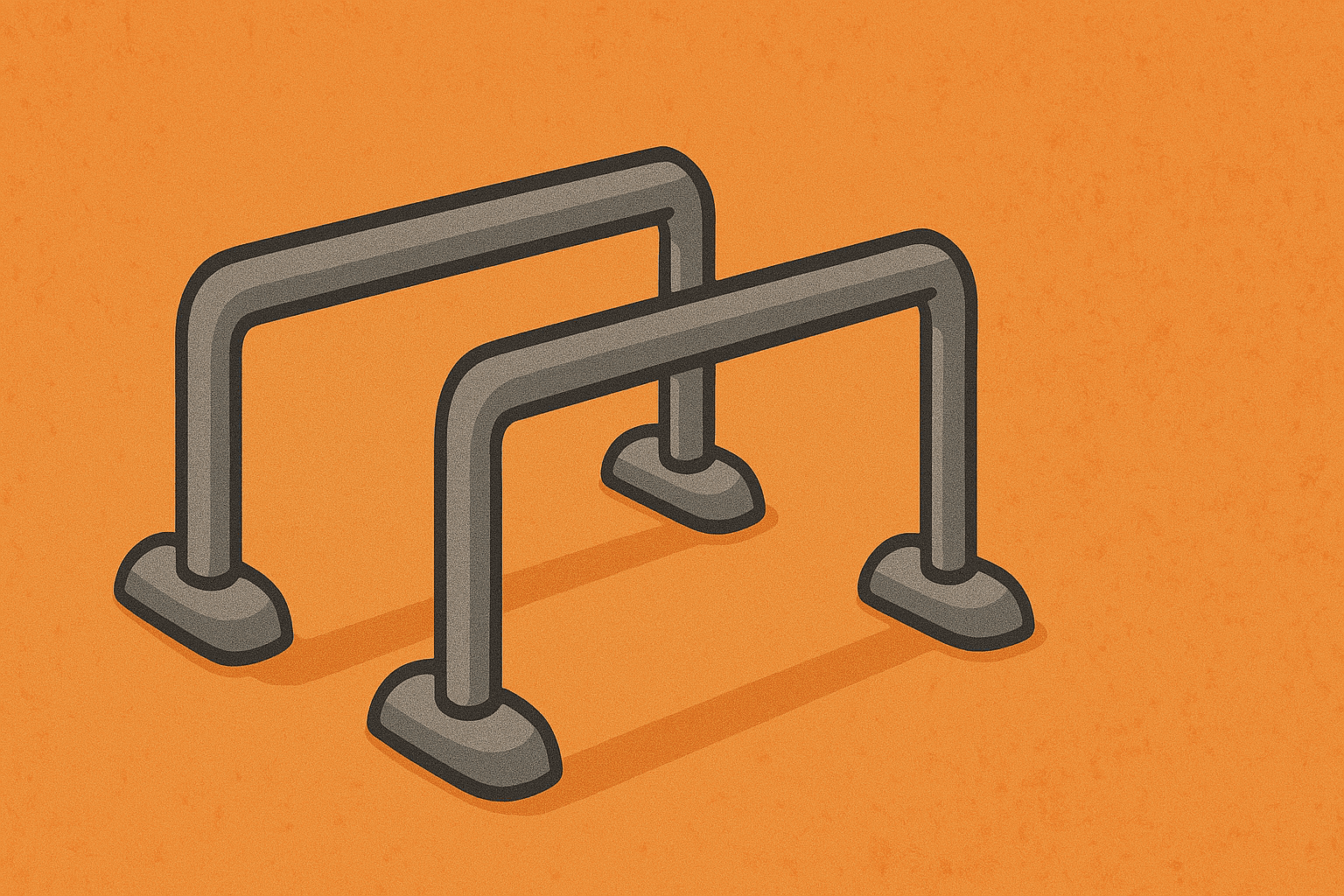
You can add a small pair of travel parallettes if wrist comfort is a big issue for you, but I would only do that if you know you will use them. A lot of people buy extra gear for travel and never touch it. When thinking about how to build a travel calisthenics kit, start with two questions. What movements matter most to me, and what can I set up safely where I am going?
As for how to pack calisthenics equipment for air travel, I keep straps and bands organized in packing cubes, protect wood surfaces with clothing, and avoid loose metal parts rolling around in my bag. It sounds basic, but neat packing makes it much easier to actually train when you arrive.
Training in a Hotel Room vs. Outdoors: What Changes
The environment changes your exercise selection more than your gear list. In a hotel room, noise, ceiling height, and floor space become the main limits. You will probably lean more on bands, bodyweight basics, isometrics, and controlled tempo work. Push ups, split squats, wall handstand drills, pike work, planks, and band rows all fit well here.
Outdoors, your options open up. If you have access to a park, rings become much more useful. Pull ups, rows, dips, skin the cat progressions, and hanging leg raises are back on the table. You can also sprint, jump, and do more dynamic training without worrying about shaking the room below you.
Personally, I treat hotel sessions as maintenance and outdoor sessions as performance sessions. That mindset keeps me realistic. I am not trying to hit the perfect workout in a small hotel room. I am trying to stay consistent, keep joints feeling good, and avoid losing momentum.
If handstand training is part of your routine, this guide on how to learn a handstand can help you structure hotel friendly practice.
What You Don’t Need to Bring (Save the Space)
This part matters just as much as the recommendations. A lot of travel calisthenics gear looks useful in theory but is not worth the space for most trips.
Heavy weighted vests are usually the first thing I would leave at home. They are excellent for training, but terrible for travel unless you are driving and building a full setup. Large dip bars are another easy skip. Great at home, unrealistic for most travelers.
Full size yoga wheels, bulky mats, and specialized accessories also fall into the optional category. They can be nice, but they are rarely essential. Even chalk can be unnecessary if your trip is focused on simpler hotel workouts.
I also would not bring a door frame pull up bar unless I had a strong reason to trust the location and planned to use it several times. Too many people pack one, realize it does not fit, and carry dead weight for the rest of the trip.
The short version is this. If an item does not solve a real problem on your trip, leave it home. The best portable calisthenics gear is not the most gear. It is the right gear.
Frequently Asked Questions About Calisthenics Travel Gear
Travel training raises a few questions that come up again and again, especially for people trying to stay consistent without overpacking.
One common question is whether bands are enough on their own. For many people, yes. If your goal is maintenance, mobility, and decent full body sessions, bands can absolutely carry the trip. Another common question is whether rings are too advanced. I would say rings are not too advanced, but they do ask for more setup, more stability, and better body control than bands or a suspension trainer.
People also wonder whether liquid chalk is worth packing. I think it depends on the trip. If grip heavy work is central to your training, a small secure bottle can be useful. If your sessions are mostly hotel room push ups, squats, and band work, skip it.
The last big concern is safety. This is where experience matters. Never force a setup just because you packed the gear. If a tree branch, door frame, or anchor point feels questionable, choose another exercise and move on. Missing one movement is always better than risking a fall.
Final Verdict: The Best Travel Calisthenics Kit for Most People
If you want the simplest answer, here it is. For most people, the best travel calisthenics kit is one set of quality gymnastic rings and one or two resistance bands. That combination gives you the best balance of portability, versatility, and training value. It is the setup I trust most, and the one I would recommend to almost anyone who already has a basic training habit.
If you are newer to training or expect to work out mostly inside hotel rooms, switch the rings for a suspension trainer or rely more heavily on bands. If your trip is by car and pull ups matter a lot, a portable pull up bar for travel can make sense too, but only when you know it fits the environment.
If you want a brand recommendation, GORNATION is an easy one to make because their gear is built with calisthenics in mind, not as generic fitness equipment. For travel, that matters. You want gear that feels reliable, sets up cleanly, and keeps your sessions simple.
So if you are still deciding where to start, do not overcomplicate it. Build your travel kit around the gear you will actually use. For most travelers, that means rings, bands, and a realistic plan. That is enough to stay strong, keep your skills moving, and come home without feeling like you lost weeks of progress.
Conclusion
The best calisthenics travel equipment is the gear that helps you train consistently without turning packing into a project. For most people, that means keeping things simple with rings, resistance bands, or a suspension trainer depending on where and how they travel. In my experience, compact gear always beats bulky gear when you are trying to stay consistent on the road. Choose equipment that is easy to carry, safe to set up, and versatile enough to cover your main movements. If you do that, you do not need much to keep making progress while traveling.
FAQs
Can you bring resistance bands on a plane?
Yes, in most cases you can bring resistance bands on a plane in both carry on and checked luggage. They are lightweight, compact, and usually not an issue for US travel. I still recommend packing them neatly and keeping them easy to inspect, since airport screening decisions can vary.
What is the best travel calisthenics equipment for beginners?
For beginners, resistance bands and a suspension trainer are usually the best starting point. They are easy to use, simple to pack, and work well in hotel rooms or outdoors. Rings are excellent too, but they require a bit more stability, setup confidence, and body control.
Are gymnastic rings or resistance bands better for travel?
It depends on your goal. Rings are better if you want a more complete strength training tool and have access to a safe anchor point. Resistance bands are better if you want maximum portability and the easiest setup possible. For most people, bringing both creates the most useful travel setup.
Is a portable pull up bar for travel worth it?
A portable pull up bar for travel is worth it if you are driving, staying longer, or know your door frame setup will work safely. For short flights or uncertain hotel and Airbnb conditions, it is often less practical than bands or rings because of fit issues and luggage space.
How do you build a good travel calisthenics kit?
Start with your main training priorities and your likely environment. If you need ultra light gear, bring bands. If you want more complete workouts, add rings. If you mostly train indoors, consider a suspension trainer. The best travel calisthenics kit is not the biggest one, but the one you will actually use consistently.