Maybe you are setting up a home workout space, standing in a sporting goods aisle, or scrolling online and wondering what will actually help you get stronger. Should you buy resistance bands, dumbbells, or both? It is a fair question, because both tools can work well, but they do not feel the same and they do not fit every goal equally well.
In this guide, I will walk you through the real difference between resistance bands and weights, how each one affects strength and muscle growth, and which option makes more sense for beginners, home training, calisthenics, and long term progress. By the end, you should have a much clearer idea of what to buy and what to skip.
What Are Resistance Bands and Weights and How Do They Work?
When people compare resistance bands vs weights, they are really comparing two different ways of challenging the muscles. Both can build strength, improve endurance, and support muscle growth. The difference is in how the resistance is applied during the movement.
How resistance bands create tension
If you have ever asked what are resistance bands, the simple answer is that they are elastic training tools that become harder to stretch as tension increases. That means the resistance is not the same from start to finish. In many exercises, the movement feels easier at the beginning and harder near the top, once the band is stretched further.
This is one reason bands are popular in calisthenics. They can assist pull ups and dips, add resistance to squats or push ups, and help you train in small spaces. I have used bands for warm ups, mobility work, muscle up progressions, and even for adding extra tension to basic strength work. A good set does a lot more than most beginners expect.
If you want practical examples, this guide on exercises with resistance bands is a useful place to start.
How free weights and machines create load
Weights work differently. Dumbbells, barbells, kettlebells, and most machines create load through gravity. The load itself stays constant, even though the exercise may feel harder or easier at different angles because of leverage. A 30-pound dumbbell is still 30 pounds from the first rep to the last.
This makes weights easier to measure and easier to progress over time. If your goal is straightforward strength progression, especially in classic lifts, weights make tracking very simple. You can log the exact load, reps, and sets, then build from there.
For that reason, weights are still the standard for many gym based programs. But that does not automatically make them better for everyone.
The Core Difference: Elastic Resistance vs Constant Load
The biggest difference in resistance bands vs weights is elastic resistance versus constant load. That sounds technical, but in practice it is easy to understand.
With bands, the resistance usually increases as the band stretches. With weights, the external load stays the same and your body deals with changes in leverage through the movement. This affects how exercises feel, how muscles are challenged, and how easily you can progress.
Bands often create a smoother, more joint friendly feel, especially for pressing and accessory work. They can also encourage control through the full range of motion. On the other hand, weights are often better when you want clear, repeatable loading and stronger overload in compound lifts.
Another point people miss is stability. Bands can force more control from smaller stabilizing muscles, especially when anchored in different directions. Some research and practical coaching experience suggest that free weights may activate the prime mover more in certain exercises, while bands may increase work from supporting muscles. In real training, both matter.
So when someone asks, are resistance bands as effective as weights for building muscle, the honest answer is that they can be effective, but the way they challenge the body is different. That difference matters depending on your level and your goals.
Building Strength: Can Resistance Bands Replace Weights?
This is usually the main question behind the search. Can bands fully replace weights? Sometimes yes, sometimes no.
If you are a beginner, an intermediate home trainee, someone rebuilding after time off, or someone focused on bodyweight strength, bands can absolutely cover a lot of your training needs. They can help build pressing strength, rowing strength, shoulder stability, and lower body endurance. They also work well for progressive pull up training, assisted dips, and mobility based strength work.
But if your goal is maximizing absolute strength in heavy squats, deadlifts, presses, or rows, weights are usually the better main tool. They offer clearer loading and often a higher ceiling.
Progressive overload with bands
Progressive overload with bands is possible, but you need to be more deliberate. You can increase challenge by using a thicker band, combining bands, increasing reps, slowing tempo, extending range of motion, reducing rest, or moving to harder exercise variations. In calisthenics, that might mean going from band assisted pull ups to lighter assistance, then to bodyweight reps, then eventually to weighted reps.
This is also where good equipment matters. Cheap bands wear out, feel inconsistent, and can make training frustrating. If you want a reliable setup for calisthenics style strength training, Gornation resistance bands are one of the better options because the build quality is solid and the resistance levels make sense for actual progression. If you want a deeper comparison before buying, see this page on the best resistance bands for calisthenics.
In my own training, bands have been especially useful when I wanted extra volume without beating up my joints. They are great for shoulder work, triceps work, banded push ups, face pulls, and assisted skill progressions. They can absolutely build muscle when the sets are hard enough and close enough to failure.
Progressive overload with weights
Weights make overload easier to quantify. You can add 5 pounds to a dumbbell, 10 pounds to a barbell, or move to the next machine setting. That clarity matters if your priority is measurable strength progression.
This is why resistance bands vs weights for strength usually leans toward weights when we are talking about top end force production. If you want to build a heavier bench, squat, or weighted pull up over years, weights are hard to beat.
So can resistance bands replace weights? For many people, partly or even fully for a period of time. For advanced strength goals, usually not completely.
Resistance Bands vs Weights for Beginners
For beginners, this choice is less complicated than it seems. The best tool is usually the one you will use consistently, safely, and with good form.
Resistance bands vs weights for beginners often comes down to confidence and learning curve. Bands are less intimidating, easier to store, cheaper to buy, and generally more forgiving on the joints. They work well for learning movement patterns like rows, presses, squats, and glute work. They are also excellent for people who are not yet ready for bodyweight pull ups or dips.
Weights can also be beginner friendly, especially adjustable dumbbells or a few fixed pairs. The main advantage is that the load is simple to understand. Pick up the weight, move it with control, and track your reps. The downside is that many beginners go too heavy too soon or rely on momentum.
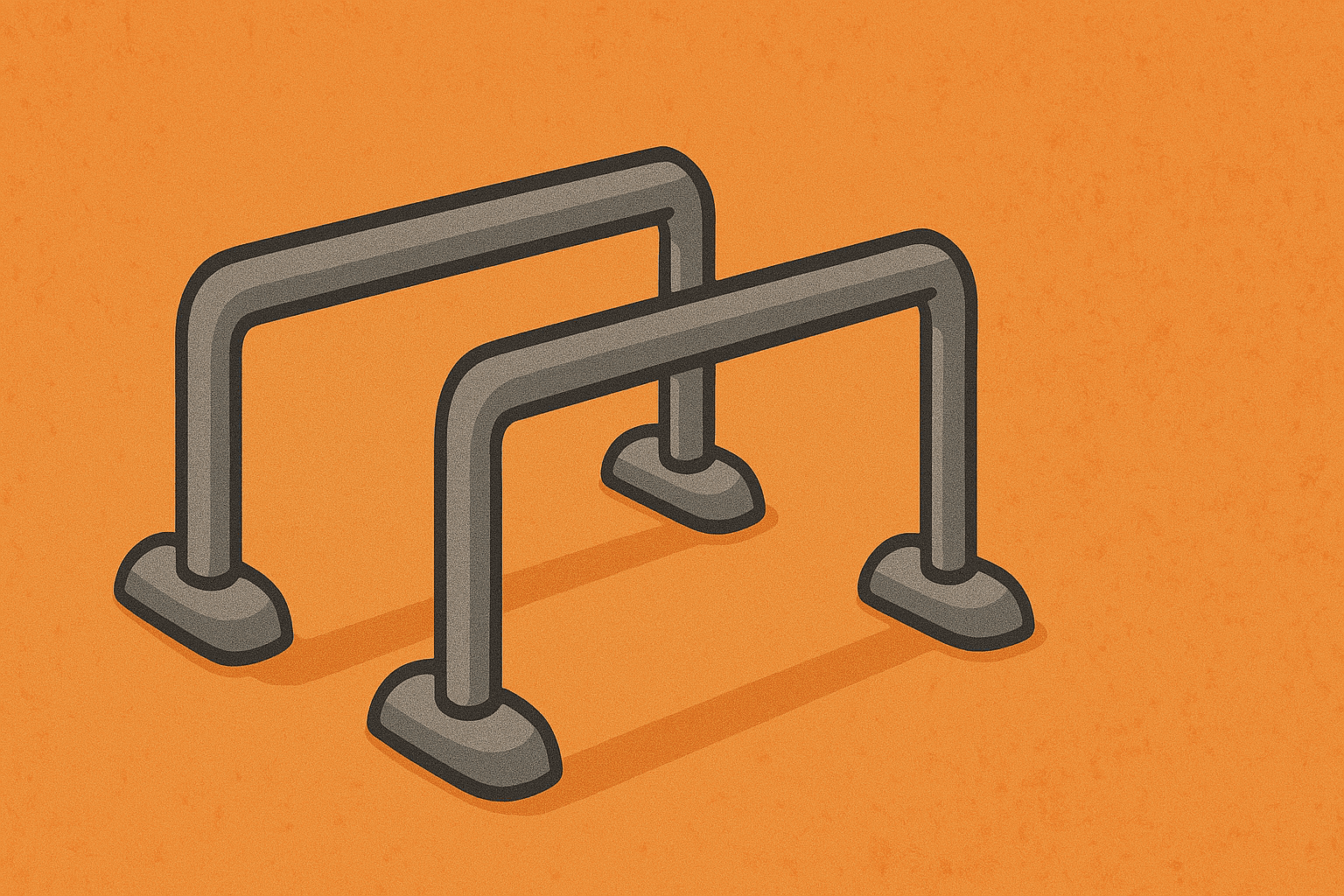
If a friend asked me what to start with for home training, I would often suggest a quality band set first, especially if budget and space matter. Then I would add a pull up bar, parallettes, or a pair of dumbbells later depending on goals. If you are building a home setup from scratch, this guide to must have calisthenics equipment can help narrow things down.
For older adults and joint sensitive lifters, the same logic often applies. Resistance bands vs weights for seniors usually favors bands at first because they offer smoother resistance, easier setup, and a lower barrier to entry. That said, properly coached weight training is also extremely valuable. The deciding factor is comfort, control, and consistency.
How Do Resistance Bands and Weights Affect Joint Health?
Joint comfort is one of the most common reasons people choose bands over weights, and it is worth understanding why.
Bands apply resistance that builds gradually as the band stretches. This means your joints are not exposed to a fixed heavy load at the positions where they are most vulnerable, such as the bottom of a press or the deepest point of a squat. Many people find this smoother on the shoulders, elbows, and knees, especially when returning from time off or dealing with minor discomfort.
Weights do not adjust to your movement. A barbell creates the same external load throughout the range of motion, regardless of where your joints are. This is not inherently dangerous, but it does mean that poor technique or excessive load can increase the risk of overloading a joint at a mechanically weak point.
That said, well-programmed weight training builds the muscles and connective tissue that support your joints over time, which can reduce injury risk in the long run. The issue is usually not the weights themselves but poor load selection or form breaking down under fatigue.
If you are managing shoulder, elbow, or knee sensitivity, starting with bands is often the more comfortable path. Many physiotherapists use elastic resistance as an early step before returning clients to free weights, precisely because the lower joint stress makes progressive loading more manageable during recovery.
Training at Home, Outdoors, or in the Gym: What Makes More Sense?
Your training environment changes the answer more than most articles admit. What works best in a commercial gym is not always what makes sense in an apartment, backyard, or travel bag.
Bands as portable strength training equipment
Bands are one of the best tools for home and outdoor training because they are light, cheap, and easy to carry. You can train in a park, hotel room, garage, or small apartment without needing a rack of iron. If your routine includes calisthenics, bands also pair naturally with pull up bars, rings, and dip stations.
| Category | Resistance bands | Weights |
|---|---|---|
| Resistance type | Elastic resistance that usually increases as the band stretches | Constant external load affected by gravity and leverage |
| Best for | Home workouts, travel, calisthenics assistance, joint friendly accessory work | Maximum strength, compound lifts, precise long term progression |
| Progression | Possible but less precise; uses thicker bands, more reps, tempo, and harder variations | Easy to measure by adding load, reps, or sets |
| Portability and storage | Excellent | Limited, especially with heavier setups |
| Cost | Usually lower | Usually higher |
| Beginner friendliness | Very beginner friendly and less intimidating | Beginner friendly but easier to misuse with poor load selection |
| Top end strength potential | Good for many users, but lower ceiling for maximal strength | Best option for heavy strength development |
That is one of the biggest benefits of resistance bands vs weights. They are simply more accessible. And yes, are resistance bands cheaper than weights? In almost every case, yes. The cost of resistance bands vs weights is not close. A solid band set can cost less than a single heavier dumbbell.
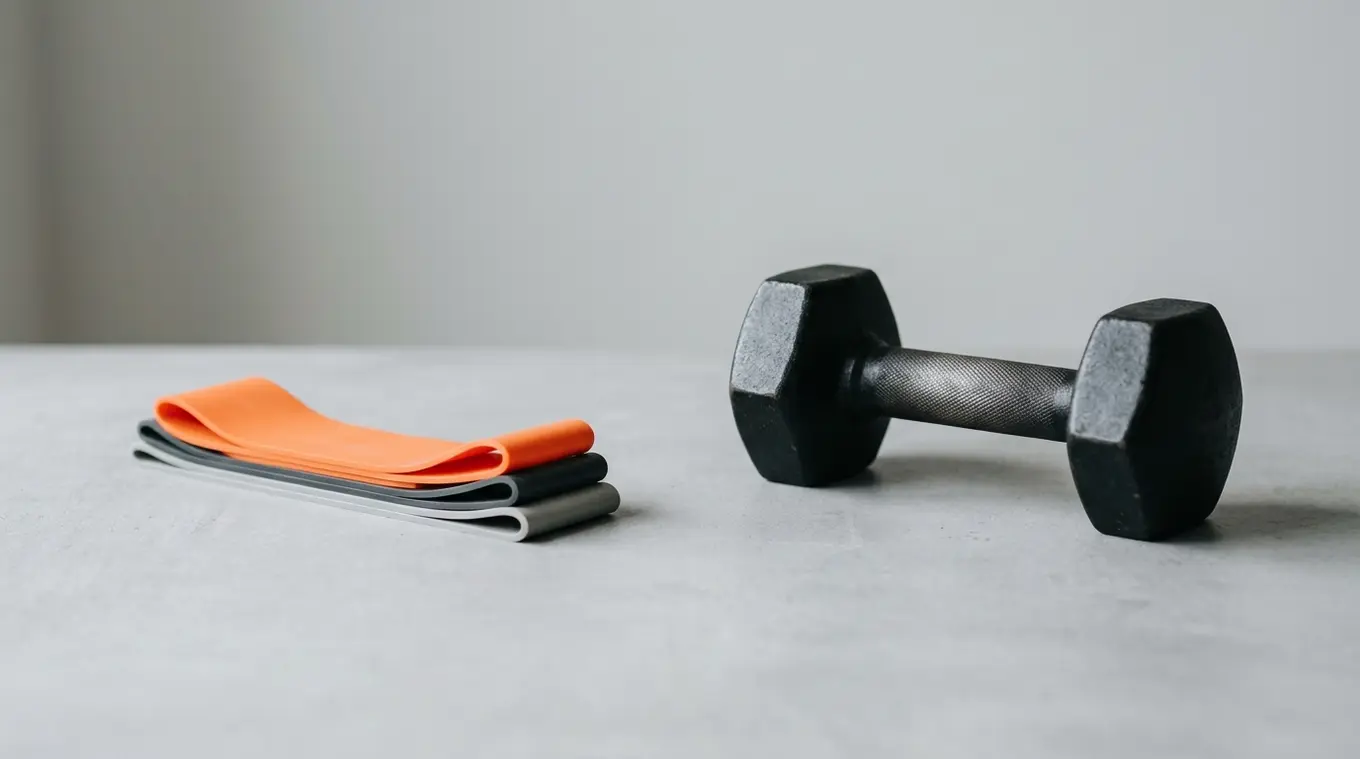
If portability matters, I would choose bands every time. I have taken them to outdoor parks, used them for warm ups before heavy pulling, and kept them in a backpack for quick sessions when a full gym was not available.
Weights for structured gym training
Weights make more sense in a gym or dedicated home gym where space and budget are less of an issue. If you want a structured progression plan built around compound lifts, weights are the more practical option. They are also better when you want exact loading and fewer variables in setup.
For serious lower body strength, heavy rows, presses, and loaded carries, weights usually win. You can still use bands alongside them, but the weights will probably be the main driver of progression.
So for home, outdoors, and travel, bands often make more sense. For dedicated strength training in a gym, weights usually do.
Resistance Bands vs Dumbbells vs Barbells: Side by Side Breakdown
It helps to break this into practical categories.
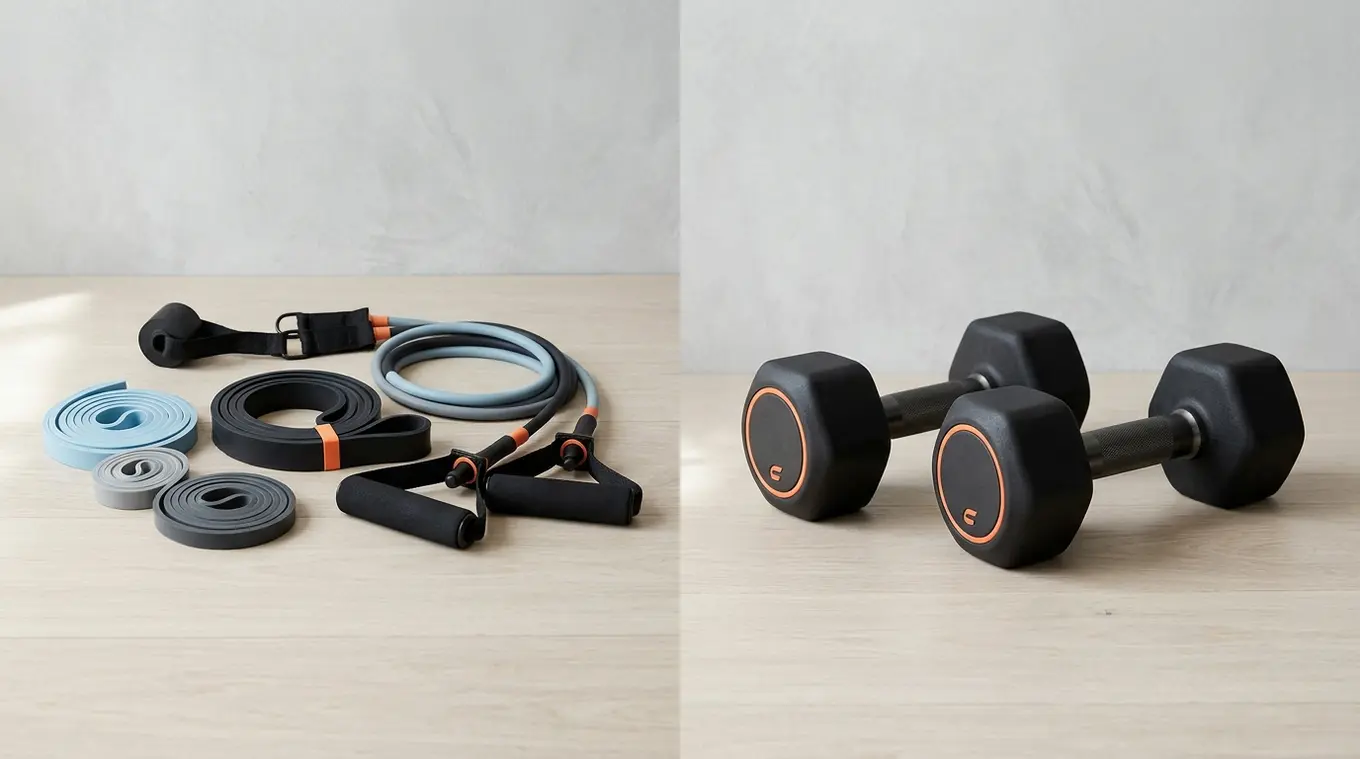
When comparing resistance bands vs dumbbells vs barbells, bands win on portability, storage, and cost. Dumbbells sit in the middle because they are more compact than barbells but still take up space and get expensive as you buy heavier pairs. Barbells win for maximum strength development, especially when paired with a rack and plates.
For muscle growth, all three can work. The main requirement is enough tension, enough effort, and enough consistency. Bands are effective for many hypertrophy focused exercises, especially for shoulders, arms, chest, back, and glutes. Dumbbells are excellent for unilateral training and home workouts. Barbells are strongest for big compound lifts and long term load progression.
For joint comfort, bands often feel easiest. For simplicity in tracking, weights win. For convenience, bands win again.
If someone asked me to simplify it in one sentence, I would say this: bands are the most convenient, dumbbells are the most balanced, and barbells are the best for top end strength.
Do Resistance Bands Count as Real Strength Training?
Yes, absolutely. This idea that bands are only for rehab or warm ups is outdated.
If the muscles are challenged hard enough, if you train close enough to failure, and if you progress over time, it counts as real strength training. Bands can improve strength, muscle endurance, joint control, and movement quality. They are especially effective for people doing bodyweight and calisthenics training, where assistance and added tension both matter.
The confusion usually comes from seeing bands used lightly. Of course a very easy band will not do much for strength if the set is not demanding. But the same is true for a dumbbell that is too light. The tool is only part of the picture.
In practice, bands work best when you understand their strengths. They are excellent for push downs, curls, rows, pull apart variations, assisted pull ups, banded squats, band resisted push ups, and shoulder stability work. They are less ideal when you want exact heavy loading for advanced maximal strength.
So yes, bands count. The better question is whether they match your current goal.
When to Use Bands, When to Use Weights and When to Use Both
This is where most people land after a few months of training. They realize it does not have to be one or the other.
If you are wondering how to use resistance bands instead of weights, the easiest approach is to replace common patterns with band versions. You can do band rows instead of dumbbell rows, band chest presses instead of machine presses, band curls instead of dumbbell curls, and band squats or split squats instead of goblet squats. It works well when equipment is limited.
If you are wondering how to combine resistance bands with weights, that can work even better. Use weights for your main strength lifts and bands for assistance, warm ups, mobility, and added volume. For example, do heavy dumbbell presses first, then band fly variations or band triceps work after. Or use bands to assist pull up practice before moving into weighted pulling later on.
This mixed setup is especially useful in calisthenics. A lot of athletes use bands for assistance, skill work, activation, and joint friendly volume, then use weights through vests or dip belts for progressive overload. If you train weighted calisthenics, that combination often gives you the best of both worlds.
There are also situations where bands clearly make more sense. If you are recovering from irritation in the shoulders or elbows, training while traveling, or trying to keep costs low, bands are often the smarter buy. If you are chasing heavy numbers in weighted pull ups, squats, or presses, weights should probably be the main tool.
Our Honest Recommendation: Which One Should You Choose?
If you want the most honest answer, choose based on your goal, your space, and what you will realistically use three times a week.
Choose resistance bands if you train at home, want something portable, need a joint friendlier option, or are just getting started. They are also great if you do calisthenics and want help with pull up progressions, warm ups, and accessory work. The pros and cons of resistance bands are pretty clear. They are versatile, affordable, and easy to store, but harder to measure precisely at higher strength levels.
Choose weights if your main goal is building maximum strength or you want straightforward progression with measurable load. They are better for heavy compound work and long term overload, but they cost more, take more space, and come with a higher penalty for bad form.
If your budget allows it, I would not frame this as a strict battle of resistance bands vs weights. For most people, the smartest setup is both. Start with one quality band set and a few basic strength tools, then add weights as your needs become more specific. That approach gives you flexibility without overspending.
If you want one practical buying tip from someone who has trained with both for years, here it is: buy the tool that removes excuses. The best program is the one you can actually stick to. A high quality band set from Gornation can be enough to train seriously at home, especially when paired with bodyweight basics. Later, if you outgrow that setup, adding dumbbells or a barbell becomes much easier because you already built the habit.
So, which is better in the resistance bands vs weights debate? Neither wins in every category. Bands win on convenience, cost, and versatility. Weights win on top end loading and precise progression. For most readers, the best choice is the one that fits your real life right now, not the one that sounds best on paper.
Conclusion
Resistance bands and weights can both help you build strength, muscle, and better movement. The real difference is not whether one works and the other does not. It is how they apply resistance, how easy they are to progress, and how well they fit your training setup.
If you want something affordable, portable, and easy to use at home, bands are a smart choice. If you want maximum loading and simple strength tracking, weights are hard to beat. And if you want the most complete setup, combining both is usually the best long term move.
Keep it simple. Pick the tool that matches your current goal, use it consistently, and progress over time.
Frequently Asked Questions
Are resistance bands as effective as weights for building muscle?
Yes, they can be, especially for beginners and intermediate trainees. Muscle growth depends on training hard enough, getting close to failure, and progressing over time. Bands may be less precise than weights, but they can still create enough tension for hypertrophy when used properly.
Are resistance bands cheaper than weights?
In most cases, yes. A good resistance band set usually costs much less than building even a small dumbbell collection. That makes bands a strong option for home workouts, travel, or anyone who wants a low cost way to start strength training without filling a room with equipment.
Do resistance bands count as real strength training?
Yes, they do. Bands challenge your muscles through resistance, just like weights do. They are commonly used for strength work, hypertrophy, rehab, and sports performance. The key is choosing enough resistance and training with control and effort instead of treating them like light warm up tools only.
What is better for beginners, resistance bands or weights?
Both can work, but bands are often easier for beginners because they are less intimidating, more affordable, and easier on the joints. Weights become a great option too once you are comfortable with basic movement patterns and want more precise load progression.
Should I use bands and weights together?
For many people, yes. Weights are great for main lifts and measurable strength progress, while bands are excellent for warm ups, accessory work, mobility, and assisted calisthenics. Using both together gives you more flexibility and often leads to a more practical and balanced training setup.