You pull your chin over the bar, again and again, but that first muscle-up still feels like a magic trick. It looks simple when advanced athletes do it: one powerful swing, a quick snap over the bar, and they end up locked out at the top like it was nothing.
In reality, the muscle-up is a big step in calisthenics. It is a skill that needs speed, timing, and confidence all at once. You will not get it in a day, and that is normal.
In this guide, you will break the move into clear parts, see what strength you need first, and follow safe progressions that you can start even if you are “just” at a basic level right now. You will also see how using solid gear, like a stable bar or rings from Calisthenics-Equipment.com, keeps your workouts safer and more consistent as you work toward that first clean rep.
Be ready for weeks or even months of training. If you can already do some pull-ups, this guide will show you how to turn them into your first one.
What Is a Muscle-Up and Why Is It So Hard?
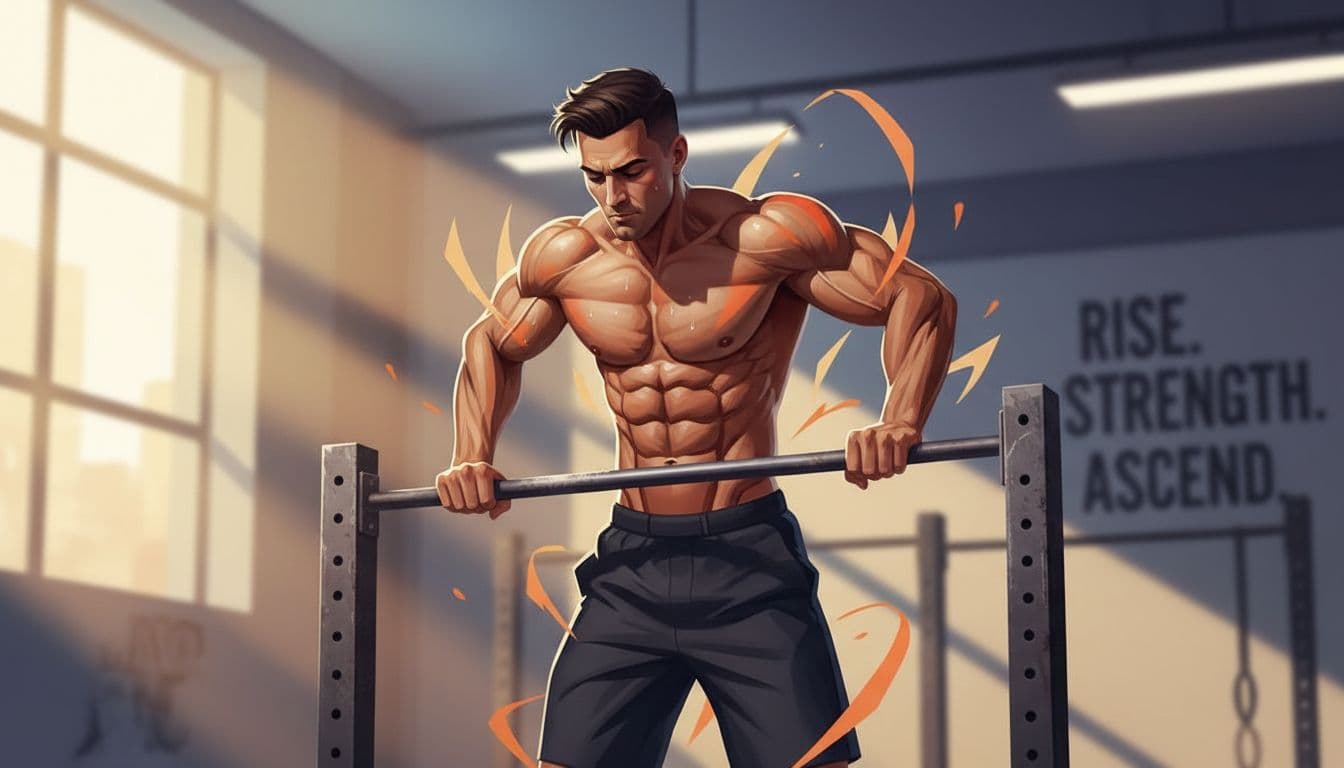
A muscle-up is basically a pull-up plus a dip exercise done in one fast motion. Instead of stopping with your chin at the bar, you pull so high that your chest passes the bar and your body lands on top of it, then you press up to straight arms.
You can think of it in three main parts:
- Powerful pull: You perform high pull-ups, pulling harder and higher while aiming your chest toward the bar.
- Fast transition: As you reach the top of the pull, your chest moves over the bar and your elbows roll from under to above it.
- Strong dip: You finish with a straight bar dip, pressing to locked out elbows on top of the bar.
The main muscles working are your back and biceps in the pull, your chest and triceps in the dip, and your shoulders and core holding everything together.
So why is it so hard at first?
- You might not have enough pulling power to get your chest near the bar.
- The transition is a weak link, since it is a new one among movement patterns.
- You may feel scared to throw yourself over the bar.
- Your technique might waste power, even if you are strong enough on paper.
The good news: when you break the muscle-up into smaller skills, it stops feeling like a magic trick and starts feeling like a clear project.
Are You Ready for Your First Muscle-Up? Prerequisites and Safety
Before you jump into drills for the muscle-up, you should know if your current fitness level allows you to train the skill safely and without constant frustration.
Fundamental strength prerequisites before training
You do not need advanced fitness to start, but you do need a solid foundation. Aim for these rough targets:
- 8 to 10 clean pull-ups
- 8 to 10 straight bar dips
- 2 to 5 explosive chest-to-bar pull-ups (if possible)
For optimal fundamental strength, work toward a minimum of 15 pull-ups as a long-term goal and 1-rep weighted pull up with 50% of your bodyweight.
“Clean form” at an 8th grade level means:
- You start from a dead hang, with straight arms.
- You do not kick wildly or twist your body.
- You move in a smooth path, not half reps.
- Your chin clearly passes the bar on every pull-up.
- Your elbows fully lock out at the bottom and top of dips.
If you are far from these numbers, your fastest path to the skill is to build your pull-up and dip numbers first. A dependable bar makes this easier. If you train at home, take a look at the Top pull-up bars for calisthenics training and pick a setup that feels safe and solid enough for hard sets.
If you lack space for a full wall bar, you can also use one of the Best doorway pull-up bars for home training to work on those base numbers without needing a full gym.
Safety first: warm-up, shoulders, and injury prevention
The skill stresses your shoulders, elbows, and wrists. A short warm-up protects them and makes you feel more capable during training.
You can use this quick routine before training:
- 20 to 30 seconds of arm circles in each direction.
- 2 sets of 15 band pull-aparts.
- 2 sets of 5 to 8 light scap pull-ups (shrug and depress your shoulder blades while hanging).
- 2 sets of 15 to 20 second hollow holds on the floor.
Listen to your joints. A dull muscle burn is fine, sharp pain is not. Stop if something feels “off” in your shoulder or elbow, and scale the exercise.
For most beginners, skill training 2 to 3 times per week is enough. Keep at least one rest day between sessions so your shoulders can recover.
Choosing the right bar or gymnastic rings for training
Your setup matters more than you might think. A shaky bar or low ceiling can ruin your confidence and your technique.
Look for:
- Bar height: High enough that your feet do not drag when you hang.
- Stability: The bar should not wobble or flex when you swing or pull hard.
- Space around the bar: Enough room in front and above the bar so you can lean over it without hitting a wall or ceiling.
If you want a permanent setup, a wall bar is a great choice. You can learn what to look for in a solid model in this Guide to sturdy wall-mounted pull-up bars.
Gymnastic rings are slightly harder because they move, but they can be kinder to your joints and allow a more natural grip angle. If you plan to work toward ring versions too, the best calisthenics rings guide walks you through what makes a good pair.
Step-by-Step Progressions: How To Train For Your First Muscle-Up
Now it is time to turn that base strength into a real muscle-up. You will follow clear steps, each with a focus and a few exercises.
Step 1: Master clean pull-ups and straight bar dips
You already saw the targets, now you will clean up the movement.
Pull-up form checklist:
- Hands just wider than shoulder-width.
- Full hang with straight arms at the bottom.
- Pull your chest toward the bar, not just your chin.
- No wild kipping, just a light natural swing if needed.
Straight bar dips form checklist for this dip exercise:
- Start on top of the bar with locked arms.
- Lean your chest slightly forward.
- Lower until your shoulder is at least level with your elbow.
- Press back up to straight arms.
Aim for 3 sets of 8 to 10 solid reps in both pull-ups and dips before you move to more advanced drills. For ideas to make your pulling stronger and less boring, you can borrow variations from this list of Effective pull-up bar exercises for strength.
Once these feel easy, you can add weight with a dip belt or vest, but that comes later in the plan.
Step 2: Build explosive power for the muscle-up
You will not muscle-up with slow, grinding pull-ups. You need speed, intent, and explosive power.
Good drills here:
- High pull-ups: Pull as high as you can, trying to touch your lower chest to the bar.
- Weighted pull-ups: clean reps with a little added weight every week does wonders.
- Band-assisted explosive pull-ups: Loop a resistance band to the bar, place your foot or knee in it, and use the help to pull faster and higher.
- Jumping pull-ups on a low bar: Use your legs just a bit from the floor to help your upper body move fast and build explosive power.
Keep sets short and sharp: 3 to 5 powerful reps per set, 4 to 6 sets total. Think about pulling the bar down to your hips, not just your chin. That mental switch alone often adds a few extra centimeters to your pull.
Step 3: Learn the false grip and strong body position
The false grip helps shorten the path during the transition. Instead of holding the bar deep in your fingers, you roll your wrist over the top so more of your palm sits above the bar. On rings, this means resting the ring closer to your wrist, not in the middle of your hand.
Useful drills:
- False grip hangs on bar or rings: Hold for 10 to 20 seconds, several sets.
- False grip ring rows: If you have rings, row your chest to the rings while keeping that rolled-over grip.
- Hollow body holds while hanging for core stability: Hang from the bar and pull your ribs down, glutes tight, legs slightly in front of you. Your body looks like a slight “C” shape.
A tight core turns your body into one strong piece. If your middle is loose, energy leaks out through swinging legs and bent hips.
Step 4: Practice muscle-up transition drills without fear
The transition is where most people “hit the brick wall”. You want to get used to moving your chest and elbows over the bar without needing a huge pull.
Try:
- Jumping muscle-ups on a low bar: Start with your feet on the ground, jump and pull at the same time, then practice leaning your chest over and finishing the dip.
- Band-assisted muscle-ups: Loop a strong band to the bar, step into it, and go through the full movement slowly.
Think about the path of your arms:
- Pull.
- Lean your chest over the bar.
- Let your elbows slide around and on top.
- Then push into the dip.
A simple cue that helps many athletes is: “Pull, lean, push.”
Step 5: Use negatives and assisted reps to build confidence
Negatives teach control and build strength in the exact path you need. Muscle-up negatives are key here.
How to do a bar muscle-up negative:
- Start on top of the bar in the finished dip position.
- Lower slowly through the dip.
- Keep your chest close to the bar as your elbows come under.
- Continue to lower with control until your arms are straight in a hang.
Aim for 3 to 5 seconds on the way down. Do 3 to 5 negatives per set, 3 to 4 sets.
You can combine these with:
- Band-assisted full muscle-ups with a lighter band.
- Partner-assisted reps, where a friend supports your legs just enough to keep you moving.
This phase might last several weeks. That is not failure. It is your body quietly building the exact strength and joint control you need for your first clean rep.
Step 6: Put it all together for your first full muscle-up
By now you can:
- Do solid pull-ups and dips.
- Pull explosively.
- Hold a strong hollow body.
- Move through the transition slowly.
Time to connect the dots.
Here is your simple checklist for the full bar muscle-up:
- Start from a light controlled swing or small kip if needed.
- As your body swings slightly forward, pull hard and fast.
- Aim to bring the bar to your lower chest or even your belly button.
- As you reach the highest point, lean your chest over the bar.
- Snap your elbows over and finish with a strong bar dip.
Helpful mental cues:
- “Big pull, quick lean, strong push.”
- “Radial pull-up: bar to my chest, chest over bar, press.”
At first, try single reps with plenty of rest in between, 60 to 90 seconds or more. Quality beats messy chains of half-reps.
Record your attempts on video. Often you are closer than you feel, and seeing yourself helps you spot if you are pulling straight up, not leaning enough, or losing tension in your core.
Common Muscle-Up Mistakes Beginners Make (And How To Fix Them)
Everyone struggles with similar issues on the way to a clean muscle-up. You are not alone if these sound familiar.
Pulling straight up instead of up and around the bar
If you pull straight toward the sky, you end up stuck under the bar with your chest too far away to roll over.
Simple technique tips:
- Aim your chest to the front edge of the bar, not straight under it.
- Let your feet drift a little in front during the swing so your body has a slight arc.
Think of your path as a curve around the bar, not a straight elevator ride.
Skipping the transition and dip strength work
Many people only grind heavy pull-ups, then wonder why they stall. The transition and dip are just as important.
Keep these in your weekly plan:
- Straight bar dips as a key dip exercise.
- Band-assisted or jumping transition drills.
Spread them over the week instead of cramming everything into one brutal session. Your shoulders will thank you.
Loose core, wild legs, and poor timing
If your legs are flailing and your core is soft, your power disappears.
Key technique tips:
- Keep your ribs down and glutes tight.
- Use a small, repeatable swing or kip with controlled knee drive, not a wild jump.
- Practice light swinging with consistent knee drive and start your pull at the same point of each swing so your timing becomes automatic.
A tight body moves like one unit and transfers power straight into the bar.
Using bands or momentum the wrong way
Bands and kipping are tools, not cheats, but they can hold you back if you abuse them.
Smart use looks like this:
- Pick a band that helps you move, but does not throw you over the bar.
- Gradually move to thinner bands over several weeks.
- Pair banded work with strict dips and negatives in the same training block.
If your band does all the work or your kip is huge and sloppy, your form will fall apart the moment you try a strict or low-swing kipping muscle-up.
Simple Training Plan and Long-Term Progress After Your First Muscle-Up
You now have the pieces. Here is how to fit them into an easy weekly plan and what to do once you finally nail that first rep.
Example weekly schedule for learning a muscle-up
You can blend practice with your normal push-pull or full-body routine. Here is a simple 3-day structure.
Day 1: Strength focus
- Pull-ups: 4 sets of 4 to 6.
- Straight bar dips: 4 sets of 6 to 10.
- Core: 3 sets of 20 to 30 second hollow holds.
Day 2: Skill and explosive focus
- Chest-to-bar or band-assisted explosive pull-ups: 5 sets of 3 to 5.
- Muscle-up exercises (jumping or Russian dips): 4 sets of 5 to 8.
- 3 to 5 slow muscle-up exercises (negatives).
Day 3: Mixed practice
- Warm-up pulls and dips.
- 6 to 10 attempts, with full rest and use bands if needed.
- Light band-assisted work to groove form if you miss most attempts.
On rest days, you can still walk, stretch, or do light leg work, but keep your shoulders fresh.
How to keep progressing after you unlock the muscle-up
Your first rep will probably feel messy. That is ok. Now begin intermediate strength training: the next goal is to turn a shaky single into smooth sets.
Progress like this:
- Build up to 3 sets of 3 to 5 clean reps, with good control on the way down.
- Keep working strict pull-ups, dips, and slow negatives so your base stays strong.
- Once that feels comfortable, start adding a bit of extra weight or harder variations.
You can learn how to pick good gear for heavier work in this dip belt buying guide, then see how it stacks up against vests in this dip belt vs weight vest comparison.
From here, future goals can include:
- Strict muscle-up with almost no kip.
- Muscle-up on gymnastic rings with a strong false grip.
- Weighted muscle-up for serious strength.
Each of these builds on the same basics you are working on right now.
Conclusion
You now know the real path to your first muscle-up: build solid pull-ups and dips, add explosive power, lock in your false grip and hollow body, drill the transition patiently, then connect everything into clean full reps. It is not magic, it is a set of skills that you stack over time.
Progress might feel slow some weeks, but every better pull, smoother negative, and cleaner transition using technique tips is a step forward. Choose stable gear, plan your sessions, and protect your joints so you can keep showing up.
If you want help picking reliable bars, rings, or weight gear to support your training, you can explore more guides and reviews on Calisthenics-Equipment.com and upgrade your setup with confidence. Now plan your first focused muscle-up week, write it down, and start chipping away at that milestone one smart session at a time.