Streetlifting is one of the simplest ways to get seriously strong with calisthenics: you keep the classic bodyweight moves, but you add weight and train them like real strength lifts. In this article, I’ll walk you through the streetlifting exercises that matter most, how to perform them cleanly, and how to progress without wrecking your elbows or shoulders. You’ll also get a practical weekly program for beginners and intermediates, plus a short equipment section so you only buy what actually helps. If you want a clear plan and honest coaching cues, you’re in the right place.
What streetlifting is and why the exercises are so effective
Streetlifting in one sentence
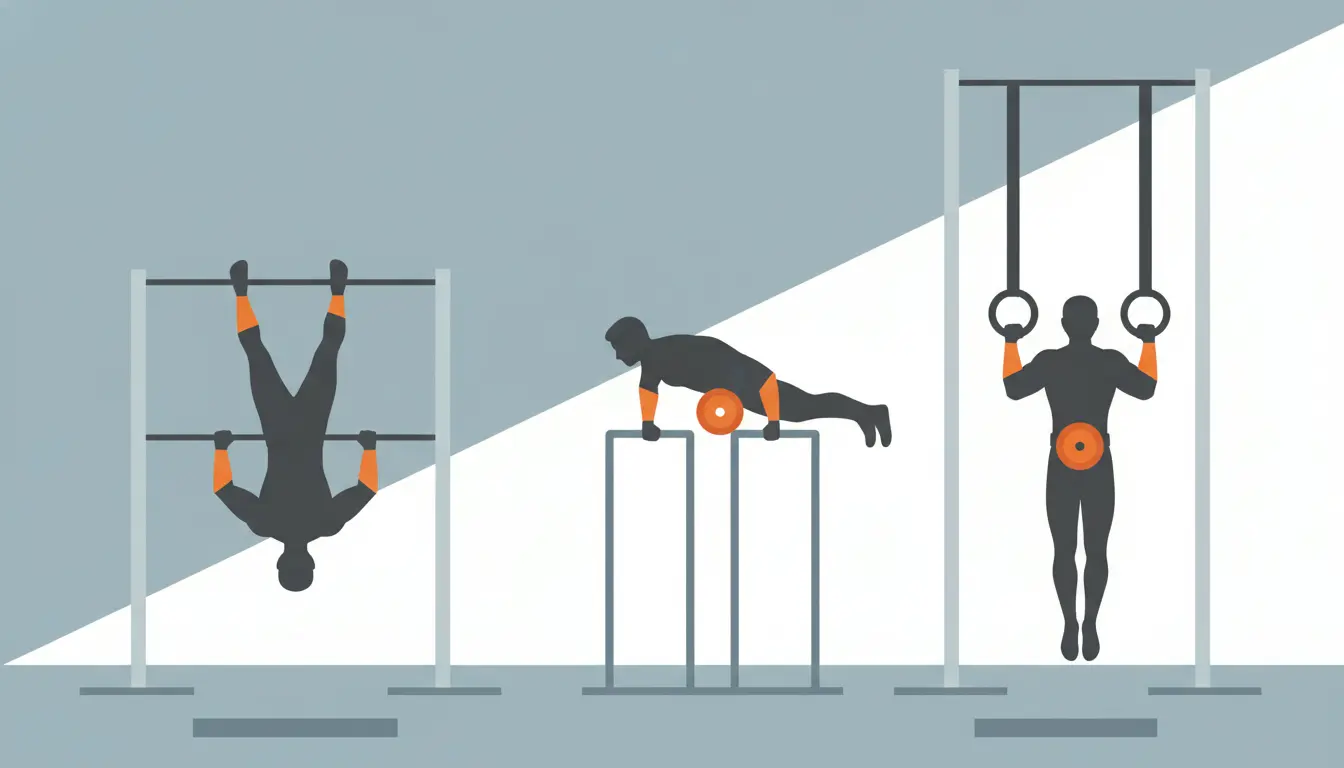
Streetlifting is weighted calisthenics focused on a small set of lifts you can load progressively: mainly the weighted pull up, weighted dip, weighted muscle up, and squat. It’s basically strength training built around bodyweight skills, but with the “numbers go up” clarity you know from barbell lifting.
Why it works for beginners and intermediates
I like streetlifting because it removes noise. Instead of chasing ten variations each week, you pick a few streetlifting exercises, practice good form, add a little weight or a rep, and repeat. That builds raw strength, thicker tendons, and better control on the bar.
Another big win is transfer. Strong weighted pull ups tend to improve rows, front lever work, and even basic posture. Strong weighted dips usually carry over to push ups, ring work, and handstand push up progressions.
Classic versus all four lifts
Some competitions only test pull ups and dips, while others include muscle ups and squats. For training, I recommend you keep at least a little lower body work in. Streetlifting is more fun when your legs and trunk can keep up with your upper body numbers.
The big four streetlifting exercises
1. Weighted pull up
The weighted pull up is the cleanest test of pulling strength in streetlifting. Your goal is a strict dead hang start, full control, and chin clearly over the bar without kicking or shortening the range.
Form cues I coach most often: start with shoulders “set” (think proud chest), squeeze glutes lightly to reduce swinging, pull your elbows down and slightly in front of you, and keep the neck neutral instead of craning to reach the bar.
Common mistakes are half reps, bouncing at the bottom, and letting the shoulders shrug up. If your shoulders slide toward your ears, you’re leaking strength and usually irritating the joint over time.
If you want extra pulling volume without beating up your elbows, add rows. This guide on how to train bodyweight rows fits perfectly as a secondary movement.
2. Weighted dip
The weighted dip is the streetlifting push lift. It hits triceps, chest, and shoulders hard, but only if you keep it honest. The key is depth and shoulder position.
Form cues: keep your shoulders down, control the descent, and reach a depth where the shoulder goes slightly below the elbow (as long as it’s pain free). Then push to a strong lockout without losing your ribcage position.
My honest take: most people load dips too early because they feel strong at the top. If you can’t keep the bottom position stable, the weight is just teaching you a messy groove. Earn the depth first, then add plates.
For a simple technique refresher, this tutorial on how to do a bodyweight dip is a useful baseline before you start piling weight on.
3. Weighted muscle up
In streetlifting, the muscle up is not a “fling yourself over” move. It’s a strict, controlled transition from pull to dip. That makes it one of the most demanding streetlifting exercises for coordination and explosive strength.
To build it, you need three ingredients: strong pull ups, strong dips, and a clean transition. I prefer you first get consistent bodyweight muscle ups with no sloppy elbow flare. Then add small weight jumps, because this lift punishes ego loading fast.
Practical progression: practice low rep sets, stay fresh, and stop each set before you grind. Grinding teaches compensations like knee drive and uneven lockouts.
4. Squat (barbell back squat or heavy squat pattern)
Yes, squats belong here. Even if streetlifting feels upper body dominant, strong legs and hips keep you athletic, help with bracing, and reduce the “all shoulders, no engine” problem.
If you have access to a rack, a barbell back squat is the simplest way to progress. If you train outdoors, you can still build a heavy squat pattern with weighted variations that keep the movement honest and deep.
Want a deeper breakdown of loading and progression? This article on how to train weighted squats is a solid companion piece.
Before you add weight: prerequisites that actually matter
Minimum strength benchmarks
You don’t need to be a beast, but you do need control. As a simple rule, I like to see:
- Pull ups: 5 to 8 strict reps with a clean dead hang
- Dips: 8 to 10 strict reps with stable shoulders
- Squats: 20 bodyweight reps with full depth and balance
- Muscle up: optional for beginners, but don’t chase weighted yet
If you’re not there, you can still “train streetlifting” by building these foundations first. Loading early is rarely the shortcut it looks like.
Warm up like you mean it
Streetlifting puts real stress on elbows, shoulders, and wrists. A good warm up isn’t fancy, it’s just consistent. Include a general raise in body temperature, then joint prep, then a few easy sets of your main lift before you load.
If you want a simple routine you can reuse, this guide on how to warm up for calisthenics training covers the basics without overcomplicating it.
Accessory streetlifting exercises that keep you progressing
Core work that carries over to the big lifts
Your trunk is the bridge between your upper body and the load. If your core collapses, your pull ups swing, your dips turn into shoulder presses, and your squats fold.
- Hollow hold: 3 sets of 20 to 30 seconds
- Plank: 3 sets of 45 to 60 seconds
- Hanging leg raise: 3 sets of 8 to 12 reps
- Ab wheel: 3 sets of 6 to 10 reps with control
Pick two per week and rotate them. More is not always better. Better is better.
Shoulder health and upper back balance
Most streetlifters do a ton of pressing and vertical pulling. What keeps shoulders happy is enough upper back volume and some scapular control work. When people tell me their elbows feel “tight,” it’s often a mix of too much intensity and too little balance work.
- Inverted rows: 3 sets of 8 to 12
- Face pulls or band pull aparts: 3 sets of 12 to 20
- Scapular pull ups: 2 sets of 8 to 10
- Scapular dips: 2 sets of 8 to 10
Keep these easy and crisp. They’re there to support your main streetlifting exercises, not to destroy you.
Leg accessories that don’t steal recovery
If you squat heavy, you don’t need a circus of leg work. One hinge pattern and one single leg movement go a long way for durability.
- Romanian deadlift: 3 to 4 sets of 6 to 10
- Bulgarian split squat: 3 sets of 8 to 12 per leg
- Back extension: 3 sets of 10 to 15
These also help people whose squats stall because their posterior chain is the weak link.
A simple streetlifting program (3 days per week)
How to use this plan
This template is aimed at beginners and early intermediates who want structure without living in the gym. Train three non consecutive days, keep 1 to 2 reps in reserve on most sets, and focus on adding a rep or a small weight increase when your form stays the same.
Rest times: 2 to 3 minutes for heavy sets, 90 to 120 seconds for moderate work, and around 60 seconds for easy accessories.
Day 1: Dip and squat focus
Weighted dips: 4 sets of 6 to 10 reps
Squat (barbell or heavy squat pattern): 4 sets of 5 to 8 reps
Ring dips or bodyweight dips: 3 sets of 8 to 12 reps
Plank variation: 3 sets of 45 to 60 seconds
Keep the dip reps clean. If you lose depth or your shoulders roll forward, reduce load and own the bottom position.
Day 2: Pull up focus
Weighted pull ups: 4 sets of 5 to 8 reps
Inverted rows or Australian pull ups: 3 sets of 10 to 15 reps
Hanging leg raise or ab wheel: 3 sets
Scapular pull ups: 2 sets of 8 to 10 reps
If you are still building your first strict reps, use assisted work. This guide on assisted pull ups is a straightforward way to bridge the gap without cheating your form.
Day 3: Technique and full body balance
Muscle up practice (banded if needed): 3 to 5 sets of 1 to 3 reps
Pull ups (bodyweight): 3 sets of 6 to 10 reps
Jump squats or box jumps: 3 sets of 6 to 10 reps
Face pulls or band pull aparts: 3 sets of 12 to 20 reps
This day should feel snappy, not exhausting. Think quality and speed. If you’re smoked, your technique work will turn into sloppy reps.
Progression: how to add weight without getting injured
Use small jumps and earn them
The safest progression is boring: keep the same exercise, keep the same range of motion, and change only one variable. I prefer adding one rep first, then adding small weight once you hit the top of the rep range with clean form.
For example, if your plan is 4 sets of 6 to 10 on weighted dips, stay at the same load until you can hit 4 sets of 10. Then increase weight slightly and drop back toward 6 to 7 reps again.
Don’t max out often
Testing a true one rep max every week is a fast way to irritate joints in streetlifting. If you like heavy singles, do them occasionally and keep them smooth. Most weeks, strength grows better with consistent submaximal work.
Deloads are not optional when life gets busy
If sleep is bad, stress is high, or your elbows feel cranky, do a lighter week: cut sets in half and keep the load moderate. In practice, this is often what keeps people training for years instead of quitting after one heroic month.
Equipment: what you actually need (and what you can skip)
The essentials for streetlifting exercises
You can start with just a bar and dip bars. But once you add load, one piece becomes almost unavoidable: a good dip belt. It’s the most practical way to load pull ups and dips without restricting breathing the way some vests do.
If you want one simple, reliable option, the Gornation Dip Belt is worth considering because it’s built for loading plates cleanly and it’s a piece of kit you’ll use for years.
Grip support that makes training smoother
On heavy pull days, grip can become the limiting factor before your back does. I’m not a fan of turning every session into a grip endurance contest. A small amount of chalk solves most slipping problems and keeps your reps consistent.
The second item I’d recommend, if you need it, is Gornation Liquid Chalk. It’s simple, it dries fast, and it’s less messy than block chalk in many gyms.
Everything else is optional. Wrist wraps, elbow sleeves, knee sleeves can help some people, but they’re not a substitute for smart volume and clean technique.
Training for competition (optional, but good to understand)
What judges usually want
Competition standards are strict because they need consistency. Expect clear lockouts, controlled reps, and full range positions. In practice, the cleaner you train, the less you need to “change your style” later.
A simple peaking approach
If you ever want to compete, the last 4 to 6 weeks are usually more intensity and less volume. Keep the main streetlifting exercises heavy, reduce accessory fatigue, and practice the exact commands and pauses you’ll see on the platform.
Veelgestelde vragen
What are the best streetlifting exercises for beginners?
The best streetlifting exercises for beginners are strict pull ups, strict dips, a squat pattern you can train consistently, and basic core work. I would delay weighted muscle ups until your pull ups and dips are solid. Build clean reps first, then add small amounts of weight.
When should I start adding weight to pull ups and dips?
Start adding weight when you can do around 5 to 8 strict pull ups and 8 to 10 strict dips with stable shoulders and no cheating. Then add small weight jumps and keep the same range of motion. If form changes, the weight is too heavy for that day.
Do I need a weight vest or a dip belt for streetlifting exercises?
For streetlifting exercises like weighted pull ups and weighted dips, a dip belt is usually the most practical option because it allows natural breathing and easy loading with plates. A weight vest can work for volume, but it often feels restrictive once loads get heavier.
How often should I train streetlifting exercises each week?
Three sessions per week is the sweet spot for most beginners and intermediates. It gives you enough frequency to practice the lifts while leaving recovery time for elbows and shoulders. If you add a fourth day, keep it light and technique focused, not another heavy day.
How do I avoid elbow and shoulder pain in streetlifting?
Warm up properly, keep your reps strict, and avoid constant maxing out. Balance heavy pulling and pushing with easy upper back work and scapular drills. Also, progress slowly: small weight jumps and occasional deload weeks usually prevent overuse issues better than any quick fix.
Streetlifting works because it’s simple: pick a few key streetlifting exercises, train them with strict form, and progress patiently. If you focus on the big four, keep a bit of accessory work for balance, and respect recovery, you’ll build strength that shows up everywhere on the bar. Start with clean bodyweight reps, add weight only when you’ve earned it, and track your sessions so progress is obvious. Do that for a few months and you’ll be surprised how quickly your pull ups and dips start feeling “light” again.