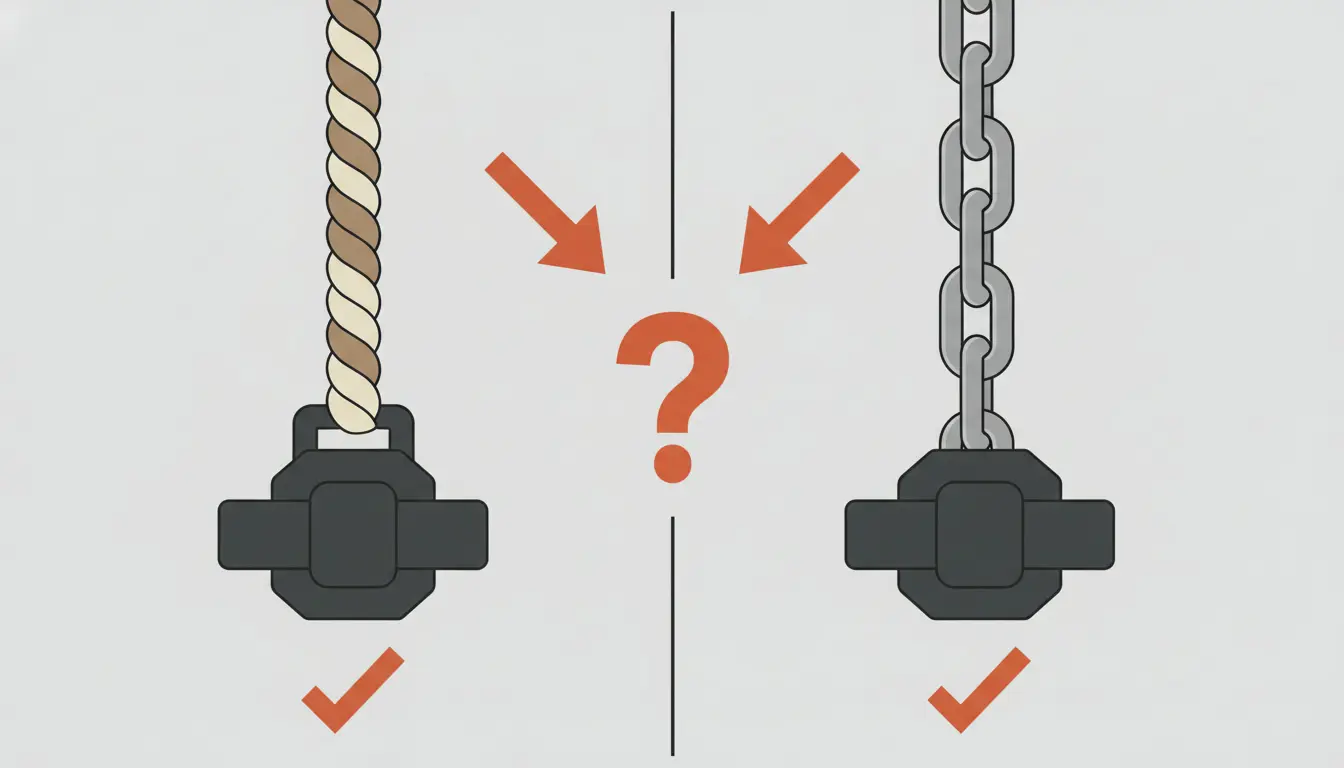
If you’re getting serious about weighted dips or pull ups, the “boring” detail that suddenly matters is what connects your belt to the plates: a rope or a chain. It sounds minor, but it affects comfort, setup speed, and how confident you feel under load. In this guide I’ll break down the real pros and cons of both options, who each one fits best, and what to look for so you don’t waste money on something annoying. You’ll also get a simple decision checklist and a few practical setup tips you can use in your next session.
Why the connector matters more than people think
When athletes ask me about weighted calisthenics, they usually focus on the belt itself. Fair. But the connector is what you touch every set, what rubs your legs, and what decides whether loading plates is smooth or a hassle.
A good connector should do three things: keep the weight stable, stay comfortable around your thighs and hips, and let you adjust quickly. If it fails any of those, you’ll either cut sets short or avoid weighted work altogether. And that’s a shame, because weighted dips and pull ups are one of the cleanest ways to keep progressing once bodyweight gets easy.
If you’re new to weighted pulling, it helps to also tighten up your base technique. If your pull up form is leaky, extra weight just magnifies it. This guide on clean reps is a solid reference: https://calisthenics-equipment.com/how-to-do-a-pull-up-with-perfect-form/.
Rope for a dip belt: what it is and how it behaves
What “rope” usually means in 2026
In dip belt talk, “rope” is often a high strength polyester strap or a daisy chain style rope with multiple loops. It typically clips into your belt with a carabiner, then threads through the hole of a plate (or around a kettlebell handle) and clips back to itself or another loop.
The biggest practical difference is that rope systems are soft and light. That changes the entire feel of the setup, especially on dips where anything sharp or heavy between your legs becomes obvious fast.
Pros of a dip belt rope
Rope wins most day to day comparisons for a reason. In normal gym or park training, it just makes life easier.
- Comfort: soft material reduces pinching and irritation around the thighs and groin.
- Low dead weight: roughly 90 to 104 g is basically nothing, so your tracking stays clean.
- Easy loading: threads through common 30 mm plate holes without fighting thick links.
- Quick adjustment: loop systems let you fine tune length in seconds, especially with numbered loops.
- Portable: it disappears in your gym bag instead of acting like a metal brick.
One underrated advantage is consistency: when setup is painless, you’re more likely to add weight in small steps, which is exactly how you get strong without wrecking your joints.
Cons of a dip belt rope
Rope isn’t perfect. The downsides are just more “situational” than chains.
- Textile wear: if the rope scrapes concrete, rough bar edges, or abrasive plates, it can wear faster than steel.
- Psychological factor: some lifters trust metal more at first, even if the rope is lab tested to very high loads.
- Length management: if you set it too long, plates can swing more on pull ups.
In my opinion, that last point is the only one that actually impacts performance. The fix is simple: run the rope shorter so the plates sit higher, closer to your center of mass.
Chain for a dip belt: what it is and when it makes sense
Why chains became the “classic” option
A steel chain is the traditional dip belt connector: clip chain to belt, run it through the plate, clip it back. It looks hardcore, it lasts, and it’s been around forever. You’ll still see it a lot in older gyms and powerlifting focused spaces.
The best thing about chain is boring but real: durability. Steel does not care about rain, sand, or being dragged across rough surfaces.
Pros of a dip belt chain
- Outdoor toughness: great for street workout parks where everything is gritty and unforgiving.
- Long lifespan: quality links can take years of abuse.
- Simple concept: no learning curve, no loop selection.
If you train almost exclusively outside and your gear lives in a backpack getting thrown around, chain is the connector that shrugs and keeps going.
Cons of a dip belt chain
This is where most people start reconsidering chain after a few sessions.
- Pinching risk: links can bite skin during dips and even on pull ups when the chain shifts.
- Clothing wear: metal rubbing fabric is a slow way to destroy your shorts.
- Extra weight: chains commonly add 300 to 600 g, sometimes more, which matters if you track progress tightly.
- Bulk: it’s annoying to pack and it clangs around in your bag.
I’ll put it bluntly: most people don’t quit chain because it’s unsafe, they quit because it’s annoying. Training is already hard, your connector shouldn’t make it harder.
Rope vs chain: a practical comparison for real training
Comfort and freedom of movement
If your main lifts are dips, rope has a clear advantage. Dips create a lot of thigh contact and hip flexion at the bottom. A soft strap reduces distraction and lets you focus on depth and control.
For pull ups, both can work well, but chain tends to sway and twist more if it’s long. Rope is easier to shorten precisely, which helps keep the plate stack stable. Stability matters more than most people think because it keeps your reps cleaner, especially when you’re near your limit.
Loading speed and adjustment
If you train in a busy gym or you superset exercises, speed matters. This is where loop based ropes are honestly “set and forget.” Once you know your usual loop for 20 kg, 30 kg, 40 kg, you can match it every time.
With chain, you can adjust, but it’s less convenient. You often end up with a length that is “good enough,” not perfect. That’s fine for casual weighted work, less ideal if you’re chasing strict progression.
Durability and training environment
Here’s the trade: rope is durable enough for most people, chain is better if your setup gets abused by weather and rough surfaces.
If you train indoors or you’re reasonably careful outdoors, rope will last well. If you train in a park where plates drag on concrete and the connector constantly scrapes, chain is the safe bet for longevity.
How to choose: my honest rule of thumb
If a friend asked me “Rope or chain for dip belt, what is best?” I’d answer like this: rope for almost everyone, chain for a specific outdoor heavy abuse niche.
Choose a rope if you want the best daily experience
- You train in a gym or you bring your gear often.
- You do a lot of weighted dips and want less pinching.
- You care about fast setup and consistent length.
- You want minimal dead weight added to your load.
Choose a chain if your priority is maximum ruggedness outdoors
- You train mostly at street workout parks in rough conditions.
- Your connector often touches abrasive surfaces.
- You value long term durability over comfort and portability.
Most beginners and intermediates improve faster when training is comfortable and repeatable. That’s why I lean rope for the majority.
Setup tips for better reps and less swinging
Get the length right
Too long is the most common mistake. The longer the connector, the more the weight can swing like a pendulum. Shorten it so the plates hang high enough that they don’t smack your knees at the bottom of a dip.
A simple test: do one slow rep. If the plates swing forward and backward after you stop moving, shorten the setup.
Load plates without fighting them
With rope, threading through the plate hole is usually easy. With chain, thick links sometimes don’t pass through smaller holes smoothly. If you use standard plates with smaller openings, rope is just less frustrating.
For kettlebells, rope is often more convenient because it wraps through the handle and sits quietly, while chain can clink and shift.
Warm up your joints before heavy weighted sets
Weighted dips and pull ups are demanding on elbows and shoulders. A short warm up makes the whole session feel better and helps you keep consistent technique. This routine is practical and easy to follow: https://calisthenics-equipment.com/how-to-warm-up-for-calisthenics-training/.
Two gear recommendations that fit most people
I’m not a fan of flooding you with product lists. For this topic, two pieces cover nearly every setup logically.
Gornation Dip Belt Rope (Regular or Pro)
If you decide rope is the way to go, the Gornation Dip Belt Rope is a clean solution: light, soft on the legs, and simple to adjust. The Pro version with numbered loops is especially nice if you like repeatable setups session to session. The main point is not the numbers though, it’s the speed and consistency it gives you.
Gornation Dip Belt (to pair with the connector)
Your connector can only feel as good as the belt it clips into. A solid dip belt distributes pressure better across the hips, which matters once loads get heavy. Pairing a reliable belt with a rope connector is, in my view, the most comfortable long term combo for weighted calisthenics.
Common mistakes I see with rope and chain setups
Going heavy before your form is stable
Adding weight is fun, but it can hide sloppy reps. If your pull ups turn into half reps, your shoulders take the hit. Keep your range strict and add load slowly. If you need it, working up with assistance can clean up your pattern first: https://calisthenics-equipment.com/how-to-do-assisted-pull-ups/.
Ignoring small discomfort until it becomes a reason to skip training
Pinching, rubbing, and constant swinging don’t sound serious, but they drain motivation. When training feels smooth, you show up more. That’s why comfort isn’t a luxury here, it’s a consistency tool.
Not accounting for chain weight when tracking
If you’re using a chain and you care about numbers, weigh the chain once and note it. Otherwise, you’ll compare sessions that aren’t truly equal. Rope makes this simpler because its weight is negligible.
Veelgestelde vragen
Rope or chain for dip belt, what is best for weighted dips?
For weighted dips, a rope is usually the best choice because it’s soft and reduces pinching where the weight hangs between your legs. It also makes it easier to fine tune the hanging height, which helps keep the plates stable and out of your way at the bottom of each rep.
Rope or chain for dip belt, what is best for heavy weighted pull ups?
Both can work for heavy pull ups, but rope often feels better in practice because you can shorten it quickly to reduce swinging. A chain is fine if durability is your top priority, especially outdoors. If you track load precisely, remember the chain adds noticeable dead weight.
Is a rope connector strong enough, or is chain safer?
A quality polyester dip belt rope can be lab tested to very high loads, far beyond what most athletes will ever hang from a belt. Chain feels reassuring because it’s steel, but safety comes more from overall build quality and correct setup than from the material alone.
Why does a chain pinch, and can you prevent it?
Chains pinch because links can shift and catch skin or fabric when your hips move, especially during dips. You can reduce it by wearing thicker shorts, keeping the chain shorter, and using a belt that keeps the connector centered. Still, if pinching keeps happening, rope is the simplest fix.
What length should I use so the plates don’t swing?
Use the shortest length that still allows full range of motion without the plates hitting your knees or the ground. In general, plates should hang high and close to your center. Do one slow rep and pause. If the weight keeps swinging after you stop, shorten the connector.
If you want the straight answer to “Rope or chain for dip belt, what is best?” it’s this: a rope is the better all around choice for most calisthenics athletes because it’s lighter, more comfortable, easier to adjust, and more pleasant to carry. A chain still makes sense if you train outdoors in rough conditions and you want maximum rugged durability above everything else.
Pick the option that removes friction from your training. The connector that feels easy to use is the one you’ll stick with, and consistency is what drives progress.